The Fight for The Republic
Reviews
Please sign in or register to add your own review.

This book is a compilation of selected few essays written by Sitaram Yechury, who was the General Secretary of Communist Party of India (Marxist) also known as CPI(M).
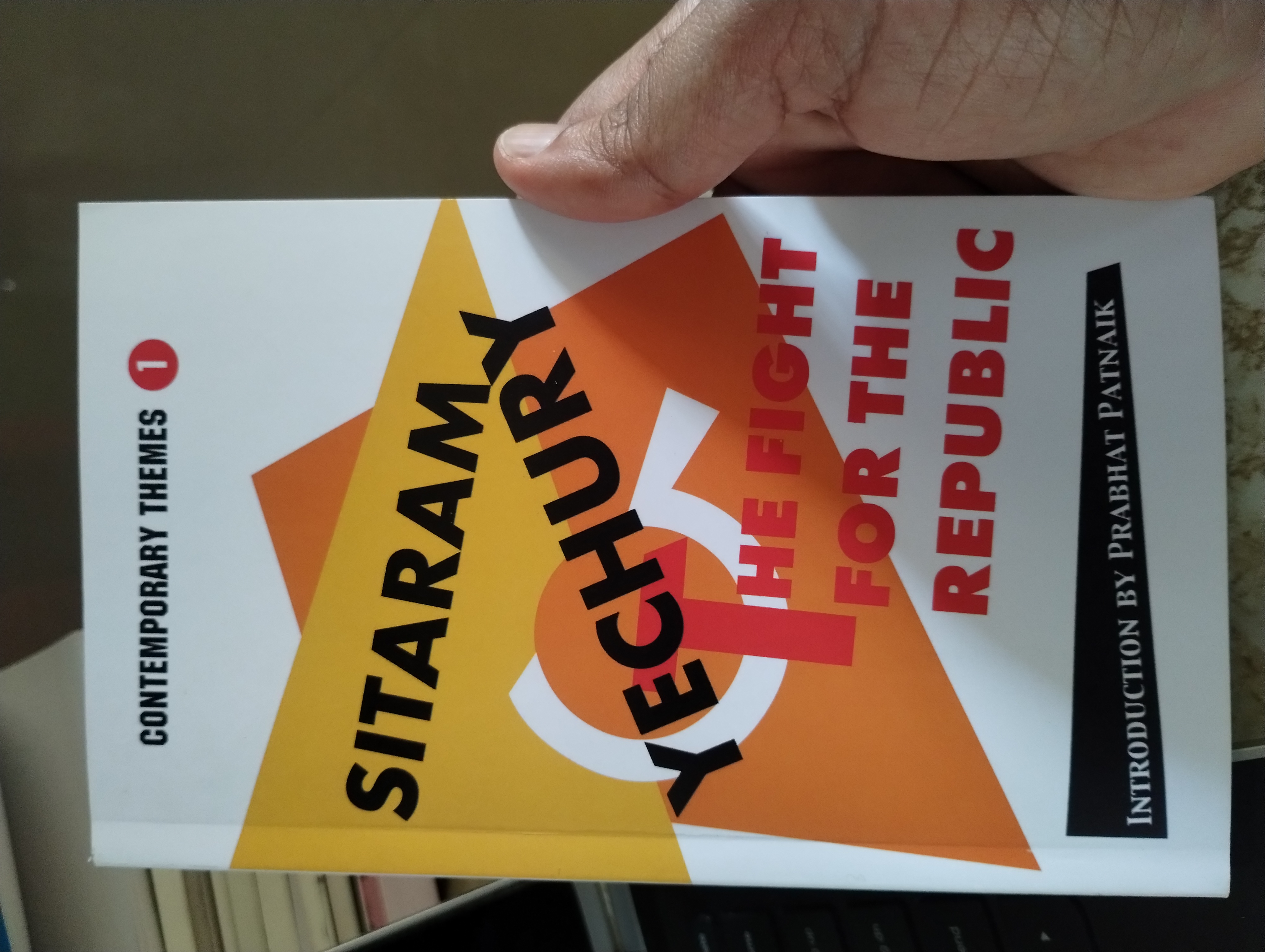
Picture of the front cover of the book “The Fight For the Republic” by Sitaram Yechury (Own work. License: CC-BY-SA.)
The book also contains an introduction by Prabhat Patnaik, a renowned Indian Marxian economist. In his introduction, he explains how it’s not just in India, but the rightward shift is a global phenomenon and how the crisis of neo-liberalism causes it.
The selected essays in the book are,
- Psuedo-Hinduism Exposed
- What is Hindu Rashtra?
- India at 75.
Psuedo-Hinduism Exposed
In this section of the book, the author debunks and counters the myths and lies peddled by the RSS (the fascist organization) & the BJP (it’s political wing) to sow their hatred towards the muslims in India. This essay was written back in 1993, 2 years after the disputed Babri Masjid was demolished. This section is mostly in the Question and Answer format.
What is Hindu Rashtra?
In this essay, the author explains the idea behind the right-wings fascist project, the Hindu (or) Hindutva Rashtra. He explains how this project stands against the “Idea of India” which was formed during the Independence struggle and exposes it from the words of it’s founders & ideologues (Golwalkar, Savarkar, Hedgewar, etc.,).
The “Idea of India” embraces linguistic, ethnic & the vast cultural diversity of India whereas “Hindutva” wants to build a monolith culture based on religious lines.
It openly embraces the Holocaust methods adopted by the Nazis of Germany & Fascists of Italy. It defies modern science & logic and creates narratives that are against popular evidence.
India at 75
Here, the author explains where India stands today, 75 years after attaining freedom, the battle of ideas between the left, right and the center. He recalls the role played by the Indian left, especially of the communists, in championing the linguistic equality, bringing the question of land distribution to the center stage and defending the true principles of Secularism (separation of state and religion).
He also touches upon how the independence struggle in India, which was basically a capitalist democratic revolution, instead of destroying, came into a compromise with Fuedalism in India out of which today we have the corporate-communal nexus fueling each other.
Finally, he concludes with a note on the immediate task to defend the Indian constitution against the fascist attack and to strengthen peoples democracy to move India towards the next stage, i.e Socialism.
Overall, this book should be read by anyone who wants to understand the historical and contemporary political developments in India.
About
-
- selected essays by Sitaram Yechury, a Marxist from India.
- Sitaram Yechury
-
IMG_20250101_114620464-1758738628002.jpg
Picture of the front cover of the book "The Fight For the Republic" by Sitaram YechurySource data licensing:
Data from OpenLibrary is in the public domain.
lib.reviews is only a small part of a larger free culture movement. We are deeply grateful to all who contribute to this movement.