Team: Interactive Fiction
Imagining worlds together
Latest review

Northway Games is a Canadian indie game development studio based in Vancouver, led by Sarah and Colin Northway. I Was a Teenage Exocolonist, released in 2022, is their most ambitious game to date.
They aptly describe it as a “narrative deckbuilding life sim”; it also incorporates elements of visual novels and dating sims. Playing with the I Was a Teenage Werewolf trope, the title winks at sci-fi pulp, but the story mostly plays it straight.
You are a crèche kid who was born in space during the twenty-year voyage of the Stratospheric to the planet Vertumna. After a preamble during which you can customize your character a bit, the game starts in earnest on the planet. Starting at age 10, you play until your character turns twenty; then you see an epilogue informed by your choices.
Named after the Roman god of seasons, Vertumna undergoes five seasons each year: Quiet, Pollen, Dry, Wet, and Glow. You make choices every month about which stats to raise through activities such as planting crops, learning engineering, or playing sportsball (sic!).
Before choosing your monthly activity, you can walk around the colony a bit. At first, you’re not allowed outside its walls; once you earn permission you can also explore the planet itself, where you advance through a set of events and encounters placed on the map. A stress score keeps you in check and has to be regularly lowered through relaxation.
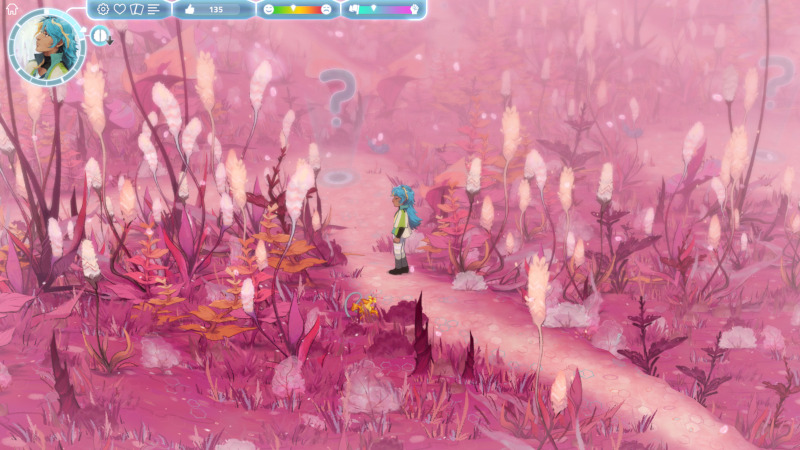
You explore the planet by walking a path that occasionally branches, progressing from one event to another. (Credit: Northway Games. Fair use.)
Interactive fiction with stats
The narrative plays out mainly in text and occasionally in large, static images. It’s driven both by who you talk to and what activities you choose, and by unavoidable key events. Vertumna is not quite Ceti Alpha V, but the planet’s flora and fauna is understandably not thrilled to be colonized and exploited, putting the settlers under constant threat.
When I say “mostly in text”, I should emphasize that there’s a fair bit of it. Even mundane events often get a paragraph or two of introductory text, and dialogue is written in the third person, like this:
Rex snorts and shakes his head. “Aw, nah, uh, this just happens sometimes, you know? After that whole fight with Vace, people got all these copycat ideas, you know, like, thinkin’ if they pushed me around a bit too, Vace would like them more.”
“People are like that sometimes,” he says, sagely. “They can be chill about hanging out in private, but around their friends, they don’t want anything to do with you. And if the bigger dog attacks, well, they wanna be on that puppy’s side, not yours.”
Rex shrugs one shoulder, indifferent. “It’s fine,” he says. “They’ll remember what I’m good at and come sneaking back eventually.”
This is in contrast with many visual novels, where dialogue is often shown next to a highlighted character. The longer form gives the story a bit more texture, but it may also give some players more reading fatigue; personally, I found myself skimming a bit, especially during low-stakes or no-stakes segments.
The choices available to you are constrained by your stats, which you raise with monthly activities. That means you’ll only see a particular slice of the game in one playthrough—e.g., if you max out engineering and organizing skills, you won’t see much of the branches related to combat.
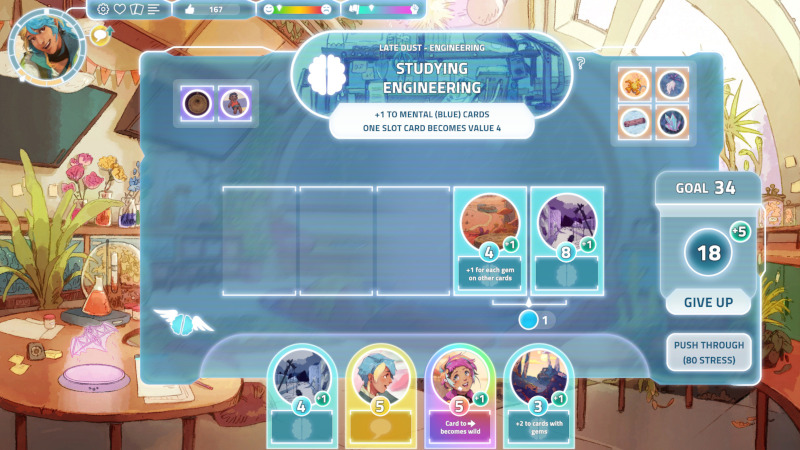
Although described as a deckbuilder, the card game has more in common with Poker than with “Slay the Spire”. You play without an opponent, and without the addictive challenges and combinatorics of something like “Balatro”. (Credit: Northway Games. Fair use.)
Deck and gear
Raising your stats and advancing through events often involves playing a short card game. There’s no opponent—you play a Poker-like game towards a target score. The game gives you the option to play in easy or hard mode. At least in easy mode, you can often still beat the mini-game by incurring a stress penalty.
To make things a bit more interesting, you can earn more points (kudos) if you hit the goal precisely. Kudos let you purchase “gear” cards, which you can equip to level up particular stats.
The combined mechanics are not terrifically well-explained (e.g., when you purchase gear, it doesn’t make it obvious how the “equip” mechanic works), but they do become clear over time. That’s somewhat consistent with the game’s expectation of repeated playthroughs.
Building a world
What makes I Was a Teenage Exocolonist truly special are not the mechanics, but the worldbuilding. Vertumna is beautifully drawn, and watching the planet change through the seasons greatly increases the immersion. The music is excellent and suits the game’s mood—slow-paced but suspenseful.
The planet’s lifeforms are described in rich detail, and there are many secrets to uncover if you’re willing to take risks. When the colony faces its first major crisis, you are there with them, hoping you survive—but you can’t be entirely sure, because people most certainly die in this game.
One of the most fascinating aspects of the game is the relationship of the colonists with Earth. Without giving anything away, suffice it to say that the exocolonists on the Stratospheric are a group with a cultural identity entirely of their own.
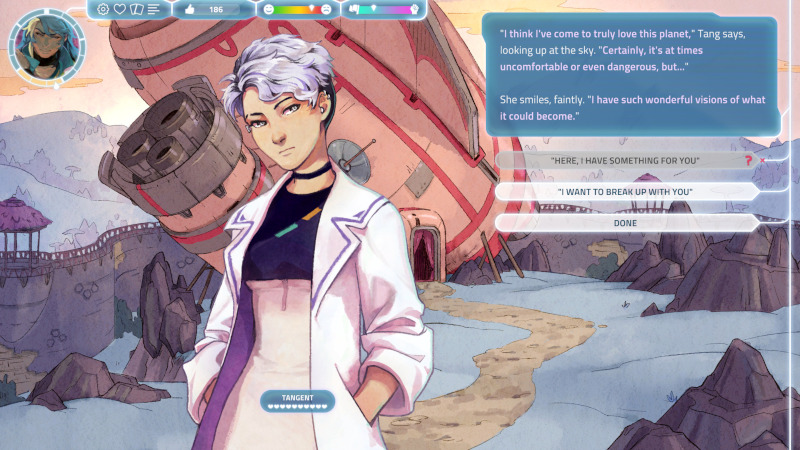
As you enter your later teenage years, you can attempt to date one of the other characters in the game. Even if things start out well, the game may still punch you in the gut later. This screenshot also highlights the stress mechanic—note the worn-down player avatar in the top left. (Credit: Northway Games. Fair use.)
Putting it all together
There’s so much evident labor of love in this game that I can’t help but give it five stars. But if I’m honest, it’s more of a 4.5, because not everything about it worked for me. There are three points of frustration I experienced playing it:
-
The gameplay loop in the colony is a bit tedious until you can go outside. For my next playthrough, I know to level up toughness and bravery early (which tends to involve sports or militaristic activities). Early on, it would have been nice to be able to join guided expeditions, or to get to know the planet in other ways.
-
The card game didn’t really “click” for me in the way that many deckbuilders have. The lack of an opponent and the limited combinatorics meant that I ended up mostly just advancing through these challenges as quickly as possible. I’m going to try again at the higher difficulty, but I was a little trepidatious to do so, because …
-
The stats system can be quite punishing. Choices are frequently unavailable to you based on your stats; even if you have spent many months of game time grinding a particular stat, it may not be quite high enough to do what you want to do. (At one point, I needed “persuasion at 100”, when it was “only” at 91.) There’s no “low chance of success”—the choice will just be locked.
So, mechanically, the game didn’t quite come together for me in the way I hoped. Lovers of dating sims should also be aware that the dating mechanics are fairly limited. They don’t influence the game much, and they don’t necessarily hold a promise of a “happily ever after”.
Still, I enjoyed my time on Vertumna enough to give it at least a second playthrough. I really do want to see what some of the other branches hold, what secrets I may have missed, and where I could have achieved a better outcome.
That’s why, ultimately, I highly recommend I Was a Teenage Exocolonist. If an immersive, text-heavy adventure on another world sounds appealing to you, you’re sure to get something out of it that will stay with you.

Never before did I crave to read every bit of text a mobile game had to offer. And I had a good reason to do so: once I’d have left, all I couldn’t explore was lost forever.
Beyond the Chiron Gate is the newest (released in 2022) entry in interactive fiction games by John Ayliff, a solo indie game developer whose other works might already be familiar to you if you read previous reviews on this very website (see Eloquence’s review of Seedship). And this game is the first one of Ayliff’s to be charged, at a (hefty) $10 price tag.
Overall, the feeling of wonder that gets you through text and the beautiful soundtrack is the main fuel of this game. It’s what kept me going until I reached the ending (which there seems to be many of!). Let me explain the setting: a probe discovered a weird thing at asteroid 2060 Chiron. Turns out, it’s a Gate to unknown reaches of space. And you get to manage a spaceship, a crew, and discover new technologies in your quest to uncover the secrets of this awesome - yet dangerous - mean of transportation, and, if you are good enough at this role, to harness it for the betterment of mankind!
Unless you’re playing like a douchebag and don’t mind getting your crew members dying over and over again, the average play time is about 2 hours. It’s a tad long to achieve in a single sitting, but this is what I recommend you do, as you will be fully “immersed” in the setting.
The game has you managing a few resources, none of them being particularly difficult to get or keep, yet you will sometimes feel like you’ll never have enough. And trust me, you won’t. The same applies for your crew members : they can get injured, or even die, and in the former case they’ll need some time to recover before being “recruitable” again for your crew. And you’ll regret not having a xenobiologist available when you are desperately craving those forsaken xeno research points!
To put things in a nutshell: Beyond the Chiron Gate is fun, especially when you want to relax in the couch or the bed with your phone. And it’s definitely a huge step up from Ayliff’s previous catalog. However, given its $10 price tag, it suffers from the repetitiveness of some of the events that occur, sometimes making the game feel “shallow” while it often demonstrates otherwise.
Yet Ayliff’s been making these Sci-Fi interactive fiction games for quite a while now, and all of them were available for free. Thus, I actually don’t mind paying $10 for Beyond the Chiron Gate. I had a great time playing it, and will certainly come back to it if the urge to explore the unexplored hits me again.
Stay safe, commander. No one knows what lies behind the Gate.
“And when they knew the Earth was doomed, they built a ship.” In one opening sentence, John Ayliff’s text-based browser game Seedship evokes stories of the journey to another world, of efforts to settle a new planet while avoiding the mistakes of the past.
1,000 colonists are all that is left of the human race, and they are asleep in hibernation chambers. You control a shipboard Artificial Intelligence that is meant to find a new home for humanity—a mission that will take thousands of years to fulfill.
You travel from one planetary system to the next, and you use scanners and surface probes to determine the suitability of candidate planets for human settlement. Does the planet have a breathable atmosphere, Earth-like gravity, tolerable temperatures, sufficient water and other resources?
Planets may hold other surprises for the colonists, from poisonous plants to high-tech ruins of previous civilizations. Based on all available information, you can decide to found a colony, or to keep searching.
Risks and Rewards
Every part of the ship, including the hibernation chambers, may be damaged during interstellar travel. On the other hand, you also have opportunities to upgrade your ship, which may improve your odds of finding a suitable home.
Ultimately, the success of your mission comes down largely to luck. You may find a lush paradise planet early, or encounter one toxic wasteland after another.
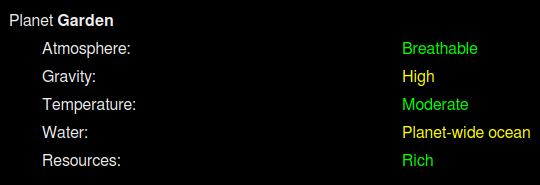
Seedship features no graphics, but its text-based interface, such as the scan results shown here, manages to convey a lot with few words. (Credit: John Ayliff. Fair use.)
What makes the game so enjoyable is the quality of the storytelling. Ayliff has stocked Seedship with many random events, from encounters with alien spaceships to the discovery of a brutal dictator among the sleeping colonists. Your choices (eject the dictator or let him sleep?) almost always have consequences, but those are often unpredictable.
When you decide that you’ve found the perfect (or at least adequate) new home for humanity, Seedship tells you about the fate of the colony. Did humanity maintain its previous level of technological achievement, or regress to a medieval level? Is your new society an enlightened utopia, or a tyrannical police state?
A single run can take only a few minutes, but you may find yourself playing Seedship for well over an hour to discover the different possible futures for humanity. If you enjoy sci-fi stories, I highly recommend giving it a try.
Team blog
Team Profile
Reviewing old and new games that are mostly text-based, from text adventures with a parser to hypertext games or “Choose Your Own Adventure” type experiences. Graphics don’t automatically disqualify a game, as long as interactive fiction is central to the gameplay.
Number of members: 3 (view list)
Number of reviews: 6
Moderators:
- Eloquencefounder
Please try for a full playthrough of any game you review, unless you find it unplayable :)