Review: Roguebook

Roguelike deckbuilders are one of my favorite indie gaming genres. Definitive titles like Slay the Spire (review) offer 100+ hours of replay value as you explore their combinatorial depths.
Roguebook came out in the summer of 2021 and was developed by Belgian studio Abrakam. The game’s premise is that the playable characters are trapped inside the eponymous book, and must fight their way out using cards.
That book metaphor shows up in a few places: the overworld is mapped out using ink and paintbrushes, and you collect pages to unlock meta-progression between runs.
But it’s a shallow conceit, and the world is a very run-off-the-mill, generic fantasy world you’ve seen a million times; the name “Faeria” tells you everything you need to know. There’s no real narrative beyond “we’re in a book!”. The brief character bios are mostly about their skillset, and intermittent “story” moments are isolated and non-specific. Even Slay the Spire, not known for its story, does a better job connecting its atmosphere and lore.
Still, there are a few things to like about Roguebook, starting with the overworld.
Echoes of Might and Magic
Maps tend to be the genre’s Achilles heel: usually you just wander one of two or three pre-defined paths and pick which monsters to fight. The worst offender may be Dicey Dungeons (review), an otherwise excellent game: the level maps are glorified interstitials that show you which battles lie ahead.
Before Roguebook, the best maps I’ve seen are the ones in Across the Obelisk, which offer interesting branches and fast travel, and are beautifully designed. But the maps are static images overlaid with random events. Not very roguelike!
In contrast, Roguebook’s overworld is a randomly generated multi-screen hexagon map you travel across. You gradually reveal it using brushes and ink you earn from battles or as part of other rewards. Loot and enemies are scatted across the map. Many battles are entirely optional if you just want to go for the boss.

Yes, that is a turtle flying on a magic carpet. (Credit: Abrakam. Fair use.)
The level-specific buildings, terrain and vegetation give the overworld a much more lived-in feeling than what you can expect from most deckbuilders. It feels just a tiny bit like the gorgeous maps in a beloved game like Heroes of Might and Magic. But I don’t want to exaggerate — the amount of “stuff” that happens on these maps is much more limited.
Still, it’s undeniably more fun to crawl these maps than it is to pick a path in Slay the Spire. There’s loot everywhere, there are towers and runes that reveal more tiles and treasures, and the scarcity of ink forces you to prioritize. As shown in the screenshot, you’ll usually only see parts of the map before progressing to the next level.
Tag Team Battles
Once you’re in a battle, it looks like any other roguelike deckbuilder: player characters on the left, enemies on the right, cards at the bottom, along with your draw pile, discard pile, and dissolve pile.
There are, of course, a few specifics. You’re always in a tag team. When you start a run, you get to choose two heroes from a total unlockable set of four (one more available as DLC). There are some nice touches here: the game has a bit of flavor speech for each hero and for the interactions between your pair. It’s not much, but it shows an attention to detail that lifts the game above feeling like a genre clone.
Defense points are shared across heroes, which keeps things simple. The position (front or back) does matter (e.g., front hero takes damage first), and quite a few mechanics are tied to hero position. For example, one card powers up every time you switch positions, which can make it extremely powerful in a long battle.
In addition, heroes can recruit “allies”. When I first drew a card called “Windstorm Colossus”, I was hoping for a dramatic addition to the gameplay:
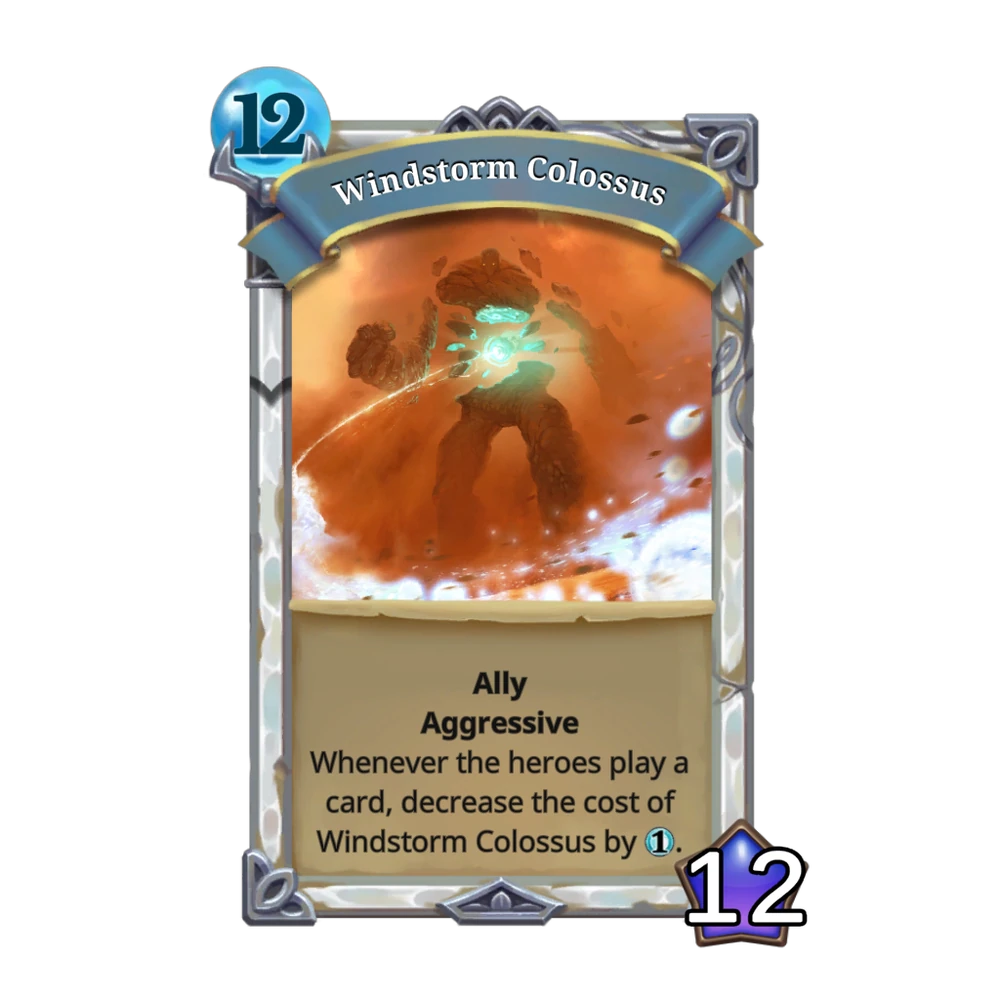 Alas, once you play them, allies just show up as unmoving, barely discernible portrait images with a number. That takes away a bit from the atmosphere! Allies can cause damage or have their own powers (like “draw a card” or “gain some energy”) that you can selectively activate.
Despite that, the ally mechanic is interesting, if a bit overpowered; it lets you effectively build a little army fighting alongside your heroes.
In addition, heroes and the team as a whole have abilities they can unlock as you increase the number of cards in your deck. Combined with treasure items that are everywhere, and gemstones you can craft onto your cards to modify them, there is quite a bit of depth once you look past the familiar facade.
Limited Difficulty
The difficulty progression is one of the game’s weaker points. It took me just 2-3 hours to beat a run, and without spoiling anything, there’s not much to it — not even the typical “that was the fake boss, now meet the real boss” final battle.
When I finally beat Slay the Spire’s Corrupt Heart, I yelled out in celebration. It was a hard-won victory that was only possible after truly mastering the game’s mechanics. You’re unlikely to have such a moment in Roguebook.
The game does offer a wide range of difficulty modifiers in the “epilogue” (its New Game Plus); if you beat it with those modifiers, you earn more “pages”, which you can use to unlock more meta-progression. But that doesn’t quite have the same draw as “must finally defeat the uberboss”.
The different characters also aren’t different enough to make you want to spend a lot of time with each new one. This is where Slay the Spire shows its superior game design: change characters, and it feels like you’re playing a new game; the mechanics really are that different. In contrast, with Roguebook, I sometimes got my two characters confused because their talents were so similar.

The combat screen should look familiar to anyone who’s played a deckbuilder. The “Soul Eater” mini-boss depicted here looks creepy, but is very easy to beat. (Credit: Abrakam. Fair use.)
The enemy design is moderately creative. You’ve got your bandits and sheep, but then you’ve also got an aerial island world populated by Ewok-like creatures that throw frogs at you. There’s just enough animation and speech for battles to feel alive and interesting.
There’s a large enough variety of bosses and mini-bosses that runs don’t quickly become repetitive, with a few novel mechanics thrown in here and there (my favorite is a boss that incarnates into other creatures while you fight him).
Hidden Gemstones
Earlier, I briefly mentioned the mechanic of modifying cards with gemstones. It’s in fact fairly well-developed: you find gems on the map or as rewards, and you can bolt them onto compatible cards to get various point or behavior modifiers (e.g., “decrease cost when you’re in the back”). “Flash gems” can be used once, and offer higher rewards (e.g., a mega-block).
But they stand out for another reason: gem mines. Unlocked via meta-progression, they start to appear randomly on each level map, and offer rooms filled with rewards. The catch is that each room has a custom trap you have to defeat.
These are regular card battles, but with trap-specific mechanics. For example, one trap door must be hit with exactly 33 points to be defeated. If you don’t make it in time, the passage door collapses, and your characters acquire injuries (unplayable extra cards) that last until the next level.
I’ve not noticed any other mid-game or late-game elements of similar complexity, but this one was a nice surprise. 30 hours in I encountered a beautifully designed “face in the wall” trap boss I’d never seen before — that’s the kind of variety you’re hoping for from a deckbuilder.
The Verdict
Ultimately, Roguebook is a good game that could have been great. Its biggest weakness is the lack of any coherent narrative or character development. A game with a sufficiently original art style can make up for that (Meteorfall: Krumit’s Tale comes to mind), but despite a few nice touches, the world of Roguebook is a bit too generic to be awesome.
The publisher follows the not atypical indie gaming strategy of overpricing the game ($25 as the Steam listing price) while regularly making it available at a massive discount (right now, GOG.com has it for $2.49). The idea, of course, is to convince you that you’re getting a superb deal.
Truth be told, at that price, it’s a steal for any fan of the genre, and it should give you at least 5-10 hours of enjoyment; more if you’re like me and want to at least unlock all the cards and relics.
I played it on my 2019 Linux machine mostly without issues. The game does get a bit sluggish when you build really large card stacks, but I experienced no crashes or game-breaking bugs.