Reviews by Eloquence

The Awesome Adventures of Captain Spirit by Dontnod Entertainment is a free promo game—its purpose is to get players interested in Life is Strange 2 (reviews). But it’s a standalone game that only has a small hook into the franchise at the very end.
You play as Chris Eriksen, a young kid living in a town in Oregon with his father Charles. It becomes clear quickly that Charles is an alcoholic whose behavior sometimes becomes abusive.
Chris, meanwhile, has his own fantasy world to escape into. He dons a cape and becomes Captain Spirit, a hero with telekinetic powers. Captain Spirit fights alongside an Avengers-style team against a team of supervillains led by a mysterious figure called Mantroid.
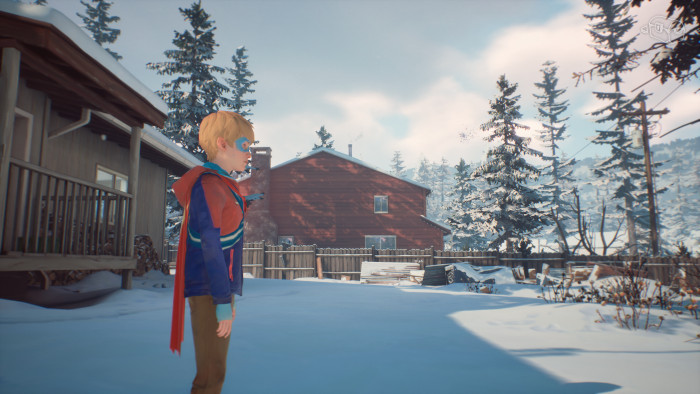
Chris in his Captain Spirit gear. (Credit: Dontnod Entertainment. Fair use.)
As you explore the house and the snowy outdoors, you can play out Chris’ fantasies, complete some chores for his dad, and learn more about his family, including his mom.
The game is rendered in beautiful 3D graphics; the outdoors environments are especially gorgeous. You walk around and look at objects or talk to people (mostly of the imaginary variety); occasionally the game switches to mini-game sequences, such as aiming snowballs at a beer can pyramid.
Captain Spirit offers only a brief window into Chris’ life, projecting a short narrative arc. In 1-2 hours of playtime, it manages to be engaging and charming while tackling difficult subjects. I would recommend the free download without reservations to anyone who enjoys exploratory games like Firewatch (reviews) or Gone Home (reviews). I played it on Linux using Proton without issues.

What is the meaning of life? In much of our philosophy, humans are the only ones qualified to answer the question. But why not seek the answer in life itself, in its grandeur of, as Darwin put it, “endless forms most beautiful and most wonderful”? In The Overstory, Richard Powers narrows it down to trees.
Through several narratives interwoven like a forest canopy, the novel implores us to slow down, to look, to listen, and to appreciate nature for what it is, not what it can be used for.
Powers knows that a novel about trees still needs humans to hold the reader’s attention. He brings to life the cast of characters like a skillful painter creating a vibrant landscape with a few brush strokes. As if they were the trees the book is about, he writes about his characters’ roots, their ancestry, their relationships with nature.
There’s Nicholas Hoel, descendant of a long line of farmers originally from Norway. Nick decides to become an artist; the family’s remarkable chestnut tree (a rare survivor of the chestnut blight that wiped out millions of trees in North America) inspires in him a fascination with nature that later turns to devotion.
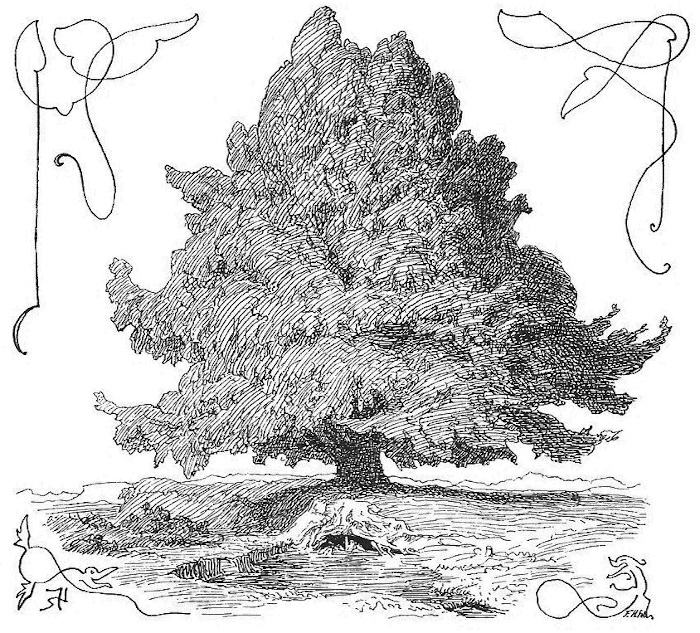
The world tree Yggdrasil from Norse cosmology as depicted by Danish artist Lorenz Frølich. (Public domain.)
Or there’s Mimi Ma, engineer, ambitious firstborn daughter of a Chinese immigrant father and a mother from Virginia. Mimi finds peace and purpose in her schedule-packed life when it’s on hold—when she’s sitting under the trees near her office during lunch. Her love for nature is rooted in many childhood trips to national parks, and in the family’s mulberry tree that she and her sisters were not supposed to climb, her father’s “silk farm”.
The stories of Mimi, Nick, and the book’s many other characters eventually intersect, as they find themselves called upon to do whatever they can to challenge and confront humanity’s suicidal trajectory of growth without limits or reason.
The Overstory explores different approaches to the natural world: the scientist’s journey, the activist’s march, the programmer’s search, the artist’s ramble, the conservationist’s last stand. It does not judge our failure to act in a specific way, but our failure to notice nature and to listen.
At 502 pages (paperback edition), The Overstory is quite hefty, but I found myself breezing through it over a weekend. Like a forest, it warrants scrutiny both as a whole and in its parts, and I was quite moved by many of its intersecting stories.
My only significant criticism is that Powers repeats certain ideas and phrases—about what life wants and is, about its interdependence and brilliance—to the point of wearing them down: a bit too much tell and too little show. Still, The Overstory makes its point beautifully: it’s time to listen to nature.
After the somewhat underwhelming Heart-Shaped Box (review), I wasn’t sure what to expect of Joe Hill’s Strange Weather. It’s a collection of four novellas published in 2017, coming in at 432 pages total (paperback). It’s fair to call it a set of horror stories, but each one is very different:
-
Snapshot is a classic “haunted artifact” story that could easily have been written by Joe Hill’s father, Stephen King. The artifact in question is an instant camera which not only preserves memories, it also takes them away.
The protagonist, an overweight and very clever kid, has a close encounter with the device’s owner. Just when you think the story is pretty much over, it goes to some very interesting places. 5/5. -
Loaded is about the intersecting stories of several people whose lives are impacted, and in some cases erased, by guns.
It’s the longest of the four pieces, but it moves at such a rapid clip that you’re unlikely to notice. This is a gut-wrenching, punishing, very American tale. 5/5.
-
Aloft is the story of Aubrey Griffin, a neurotic musician who is reluctantly participating in a skydiving trip to honor a deceased loved one. But instead of safe and sound on planet Earth, Aubrey finds himself in a strange place that seems to never want to let him go.
It’s an imaginative, not especially scary adventure that offers some reprieve between the two violent tales that precede and follow it. It invests us in its colorful characters, but that investment never quite pays off. Aloft might have worked better as a full-length novel. 3.5/5. -
Rain is a return to blood-splattering horror, in this case inflicted by the weather itself, in a scenario reminiscent of Vonnegut’s Cat’s Cradle. Our protagonist, a young lesbian woman with the unlikely name Honeysuckle Speck, barely escapes the first wave of carnage.
As she makes her way through a Colorado hellscape on a personal quest, she faces a wannabe vampire, members of a religious cult, a mad Russian, an MMA fighter, a bigoted neighbor, and other witnesses to the apocalypse. Meanwhile, Donald Trump is president, and he provides the deranged all-caps tweets you would expect from him.It’s horror, but it’s also tongue-in-cheek, and it works on both levels. 5/5.
For three of the four stories, I felt that the length was just about perfect, showing a remarkable mastery of the novella form. Hill also uses his talent for creating memorable characters, which was already evident in Heart-Shaped Box, to its fullest.
I recommend Strange Weather without reservations, but know what you’re signing up for. Loaded is the centerpiece novella, and it’s a brutal story about a very real subject (gun violence). This not a book you’ll want to pick up unless you’re in the right headspace for it.
The world as we know it has ended long ago, and the ruins of San Francisco are crawling with orcs and goblins. Your are a novice necromancer, in pursuit of your brother, who has abandoned you and your family in search of fame and fortune. Perhaps you will find him somewhere in the Transamerica Pyramid, one of the few tall buildings that are still standing.
Knights of San Francisco is a choice-based adventure game for Android and iOS made by a single developer, Filip Hracek, and a single illustrator, Alec Webb. It is mostly text-based, and the gameplay is somewhat reminiscent of Choice of Games titles, but Knights also severs to showcase the game’s own engine, Egamebook.
You move through the game’s world by selecting destinations on a map. As you do so, you encounter allies, enemies, and items that may help you on your quest. During turn-based combat, you control only your own actions (your allies attack independently). You are given a surprisingly large set of choices, from feinting, to casting a spell, to kicking a weapon out of the way.
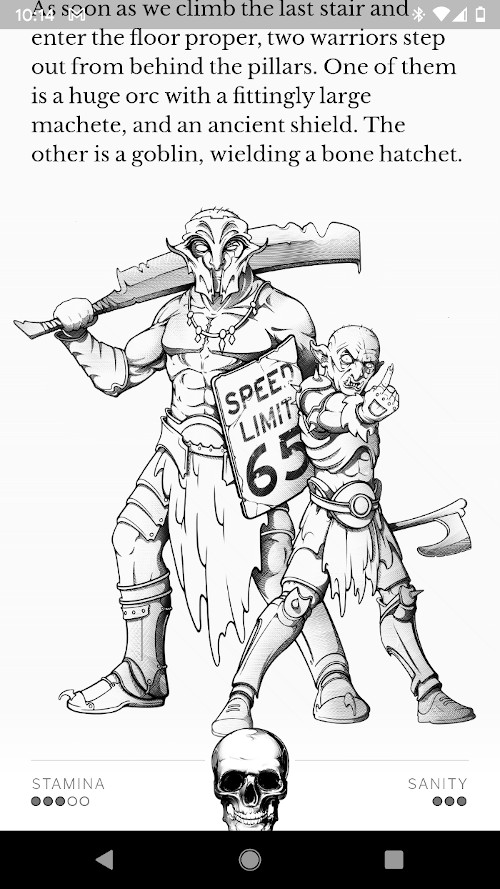
The game is mostly text-based, but the illustrations by Alec Webb help to establish the setting. (Credit: Raindead Games / Alec Webb. Fair use.)
After each choice, a dice roll determines success or failure; if you fail, you can drain your stamina or sanity points to re-roll. The game generates text that describes the result of each combatant’s actions.
There are no hitpoints or levels, and death can come quickly. Still, thanks to your allies, the necromancy skill, restorative items, and the re-roll option, most battles will not present much of a challenge. Just in case, the game lets you rewind bad decisions (I only had to do so once).
The story is told in short paragraphs, much of it through dialog with friendly characters which you can skip if you prefer to focus on combat. The writing is solid, and you do get to make a choices that will shape the story and its ending.
If you’re looking for a game that will give you hours of replay value, this isn’t it—a playthrough takes about 60-90 minutes, and there’s not much that changes on a second run. But it’s immersive, novel, and fun, and only costs $3. Whether or not you pick this one up, Raindead Games is worth keeping an eye on.

I read my first Stephen King book when I was a teenager, and I remain one of his constant readers decades later. He’s incredibly prolific, but he won’t live forever (unless he’s made some kind of special arrangement). Who will I turn to then in order to fill the King-shaped void in my life? Perhaps Joe Hill, AKA Joseph Hillström King.
King shortened his middle name to create his nom de plume so people wouldn’t do what I’m doing: pay attention to his work because of his father’s. By now that ship has sailed, and comparisons are inevitable the moment you look at Hill’s photo on a book jacket. Joe Hill has followed in his father’s footsteps as a horror author, but he’s also explored new territory as the writer of Locke & Key, a graphic novel adapted into a TV series.
Heart-Shaped Box (2007) was Hill’s debut novel. Named after the Nirvana song, it’s about the haunting of a washed-up rock star named Judas Coyne by a ghost he buys on the Internet. The book wastes little time with questions or preliminaries. Soon, Coyne and his hot, young goth girlfriend (the latest of many) are on the run for their lives, from an entity that seems capable of anything and impossible to defeat.
Each chapter is named after a famous rock song, and Hill’s story is loud, fast, violent, engaging and—not especially scary. Coyne is not a likable main character, nor is he easily scared; the stakes are mostly limited to the survival of him and the people around him; the ghost is creepy but all too familiar and human in its evil.
That doesn’t make Heart-Shaped Box a bad story; I enjoyed my time with it, and finished it in a few days. But as far as horror goes, it lacks the menacing quality of the best works of the genre; it never plants an idea in your head that comes back when you’re alone in the house and it’s after midnight. 3.5 stars, rounded down because I’m hoping Hill’s later works will pack more of a punch.
Take A Hike! is a very short visual novel by Jane Titor about three teenagers with botanically inspired names (Olive, Sage, and Heather) and their experiences during a hike in the woods. All are part of an outdoor education class led by a young teacher named Miss Yarrow. After Sage separates from the group, Olive runs after her to ensure she doesn’t get lost, and the two are soon joined by Heather.
This is a kinetic visual novel, meaning that you don’t get to make any choices. Or, as the game’s description puts it: “Follow three stressed-out teens on a journey full of bickering, mosquitoes, and self-discovery.”
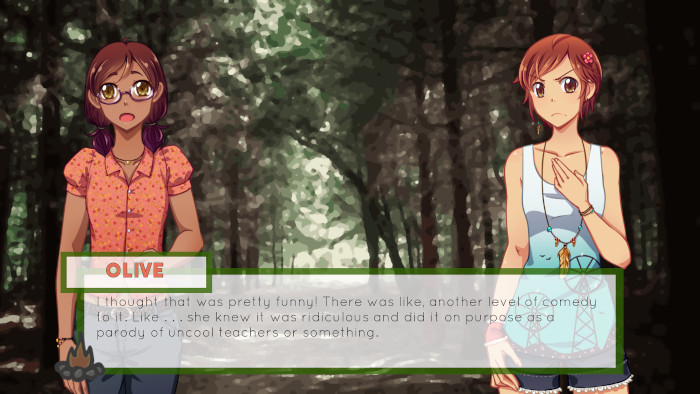
The game includes only small amounts of original art, but the sprite assets by DejiNyucu are used to good effect throughout. (Credit: Jane Titor / DejiNyucu. Fair use.)
It’s a romantic story that doesn’t quite go where you might think it will. The writing is good, with a couple of moments that had me laugh out loud (especially the scenes with Miss Yarrow, the true heroine of this game). Take A Hike! is only about 30 minutes long; it’s $3.50 at full price, but if you have bought the Bundle for Palestinian Aid, you already own it. I enjoyed the hike, and only regretted that I didn’t get to spend more time with these characters.
The Boy in the Book is a web-based full-motion video game; the website describes it as ”an interactive true story in 10 chapters”. It is free without any strings attached, and has also been published in book form and performed as a live show.
The game/documentary is premised on the random discovery of pages from an old diary in a stack of Choose Your Own Adventure books bought on eBay. In almost stenographic shorthand, the diary pages record the author’s experiences with bullying, with their attempts to overcome extreme shyness, and even suicidal thoughts.
The notes suggest that the diary’s author, a boy named Terence Prendergast, was born in 1975. Is he alive, and if so, what happened to him since he wrote the diary?
Choices in the chatroom
The buyer of the books, a Welsh writer and performer named Nathan Penlington, sets out to discover and document the story of the “boy in the book” together with his friends Fernando, Sam, Nick—and with you, the player.
You interact with Nathan & friends through an instant message chatroom in which the group discusses what to do: which leads to pursue to locate the author of the diary, which detours to take along the way, and whether to persist in what increasingly seems like a futile quest.
As the player, you are presented with dialog options throughout the chat, which sometimes represent important forks in the road. Depending on your choices, different responses, videos and images appear in the chatroom. They are grounded in the same reality (e.g., the same interviews), but put the focus on different narrative paths.
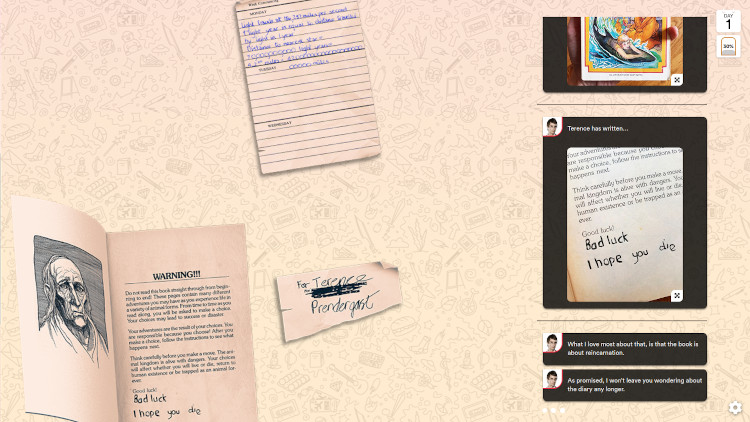
The events of the game play out in a chatroom with Nathan and his friends. Like in a “Choose Your Own Adventure” book, you get to make choices about how their effort to document the story of “the boy in the book” unfolds. (Credit: https://www.theboyinthebook.co.uk/. Fair use.)
Abort, abort, abort?
You can rewind your choices and take as many different paths as you like, and the game auto-saves in your browser (if you don’t play it in private browsing mode).
To underscore that these choices are meaningful, Nathan asks you in the first chapter whether he should pursue his obsession with the diary at all. If you tell him not to, the story comes to a quick end and the credits roll.
Nathan’s question is a fair one. The ethics of the whole undertaking can sometimes feel uncomfortable, since the found diary pages are presented as the writings of a private individual. As you play through the story, it becomes clear that everyone is appearing on screen willingly.
The Verdict
While the story feels a bit padded out in the way many documentaries are, I still found it was ultimately beautifully done and well worth my time. I watched two of the main endings and was moved by both of them. In total, I spent about two hours with The Boy in the Book.
The game features gorgeous illustrations and a fitting soundtrack. Overall, I found that the web-based format worked surprisingly well, with two exceptions: 1) The rewind feature didn’t always work for me (text was sometimes repeated or did not appear until I reloaded), 2) the game’s music kept playing even during videos which had their own music in them, which was a bit distracting.
The individual chapters are quite short. I would recommend giving the first one a try. If you find Nathan in particular offputting at all, you’re not going to enjoy The Boy in the Book—he’s on screen a lot. But if you like his style, and if you share at least some appreciation for Choose Your Own Adventure books, you’re likely to have a good time.
Before I Forget is a narrative game by 3-Fold Games, a two person development team based in the UK. It tells the story of Sunita Appleby, a woman who is struggling to remember her life and to navigate her day-to-day reality. You play as Sunita and explore her home, looking for her husband, Dylan. The game uses color, sound and music to evoke Sunita’s memories and to guide her on her path.
Some of Sunita’s memories form brief, interactive experiences in their own right. For example, in one childhood memory, her aunt explains the constellations to her, using references from Indian mythology (Prajapati for Orion, Saptarishi for the Big Dipper). As the player, you follow the directions of “Leela auntie” to identify the stars she talks about on the night sky.
While the graphics are very basic throughout the game, the voice acting and music help immerse the player in Sunita’s world.
The experience is about an hour long. The game also includes optional developer commentary. When it is enabled, little speech bubbles appear in various locations that let you play audio commentary recordings that are relevant to the specific setting you are in.
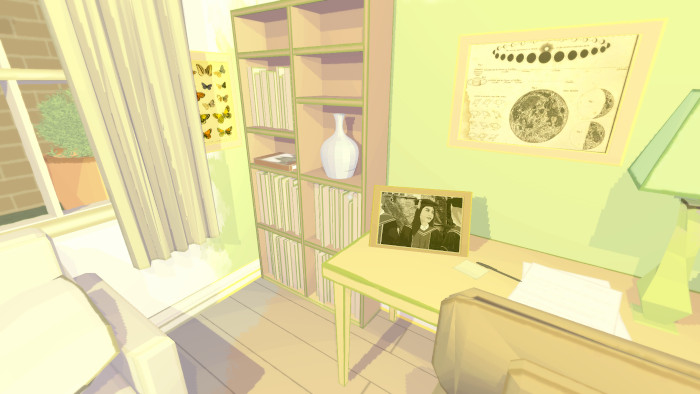
As you examine the objects in Sunita’s home, the world around you changes from grayscale to color, creating a sense of discovery. (Credit: 3-Fold Games. Fair use.)
Before I Forget encourages us to treasure our life and the people in it; it also tries to convey the experience of dementia in a way that builds understanding and connection. But above all it is telling a story which is building up towards a significant emotional impact.
If you enjoyed games like Gone Home (review) and Firewatch (review), you are likely to appreciate the experience 3-Fold Games have created. The asking price of $8 is a bit high for a one hour game, but if you purchased itch.io’s Bundle for Palestinian Aid, remember that you already own Before I Forget. Unless you’re in an emotionally dark place or the topic strikes too close to home, you won’t regret going on this short narrative journey.
Bury Me, My Love is a choice-driven visual novel about the refugee crisis that has resulted from the Syrian Civil War. It is told in the form of text messages exchanged between a young woman, Nour, and her husband, Majd. Nour is trying to make her way to Europe, while Majd is forced to remain behind to take care of older family members.
According to the game’s website, the editorial team of the project includes the author of the Le Monde feature “Dans le téléphone d’une migrante syrienne” (“On the phone of a Syrian migrant”) and one of the migrant women portrayed in that story. While the game is not biographical, it attempts to present a realistic composite informed by real experiences.
Messages from your wife
You play as Majd. You click to advance the story, but you also have to make a significant number of choices throughout. Nour asks for your advice on everything—what mode of transportation she should use, where she should stash her cash, what kind of smuggler to trust, which countries to travel to.
The game has many endings, not all of them positive; when you are finished, you can review Nour’s journey on a map.
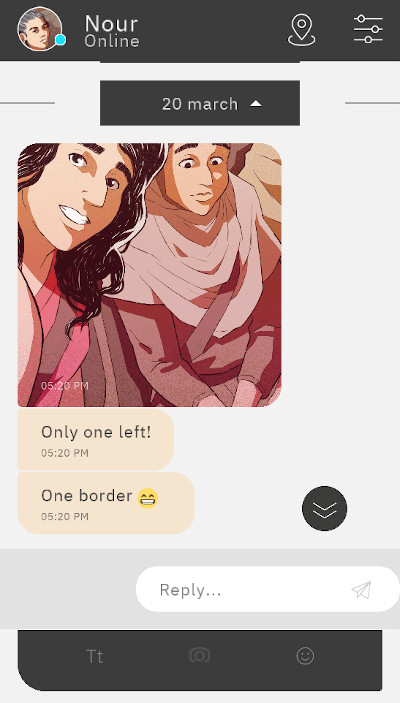
As the player, you experience Nour’s arduous journey through her husband’s phone. (Credit: The Pixel Hunt, Figs and ARTE France. Fair use.)
The intention is clearly to humanize a crisis of unimaginable proportions. By experiencing Nour’s journey through a series of WhatsApp messages, we are invited to relate it to our own experiences. As developer Florent Maurin described his reaction to the Le Monde feature (which heavily relied on the text message format):
“It was really powerful as it felt very familiar to me and how I use WhatsApp to chat with my friends and family, sending emojis, jokes and pictures. But it was also very odd because they were discussing matters of life and death.”
Clearly, Bury Me, My Love attempts to replicate these sensations: familiarity, shock, confusion. And it often succeeds at building on the reading experience—waiting to hear from Nour can be genuinely nerve-wrecking. If you don’t mind spoilers, Florent Maurin’s GDC presentation gives some insights into the design philosophy and ethics behind the game.
Nightmarish choices
But the game is disconcerting in other ways in which a newspaper article is not. As the player, you are asked to make choices which may lead Nour to safety. But that can be seen as putting the impetus on refugees to make the “right” choices, rather than on governments.
You exclusively play as Majd, and all branching paths are the result of his messages. In spite of the best efforts of the developers, I felt that Nour was underdeveloped as a character, and would have liked to see the journey through her eyes. I would have also appreciated additional context, such as newspaper clippings from the time.
It took me about a couple of hours to play the game. Nour made it to safety in my first playthrough. The game suggested that I try other paths, but that seemed almost like an appeal to sadism, considering that some of these choices may well lead to Nour’s death.
While the game was included in itch.io’s massive Bundle for Palestinian Aid, it’s ordinarily sold as a commercial title ($5 on Steam), and proceeds do not go to any charitable cause. I played the game on Linux through Proton without issues.
The Verdict
Bury Me, My Love attempts to do something very important—to help us empathize with experiences that news reports usually keep at a comfortable distance. It ultimately falls short of this ambition, both because it is too much like a game (centering player choices) and not enough like one (restricting our perspective to Majd’s mobile phone). 3.5 stars, rounded down.
Highway Blossoms is a romantic visual novel about two young women (Amber and Marina) who meet through a chance encounter on the side of the road, and soon embark on an adventure together. It is a 4-6 hour long story told in text, pictures, animations, music, sound and voice. As the player, you don’t get to make any choices—your influence ends on the settings screen.
The story is told in the first person from the perspective of Amber, who is on a road trip in her grandfather’s RV. Her grandfather, who played a central role in Amber’s life, has recently passed away, and the trip is Amber’s way to process the loss. In this healing journey, she is aided by a bucket full of cassette tapes that she and “gramps” used to listen to.
On the side of the road in New Mexico, Amber first spots Marina, whose car appears to have broken down, and offers her assistance. It turns out that Marina is bubbly, cheerful, and entirely unprepared for her first trip away from home.
Soon enough, Marina draws a reluctant Amber into the purpose of her own trip: a treasure hunt across multiple states, based on claims in an old journal ostensibly written by a gold rush era miner.
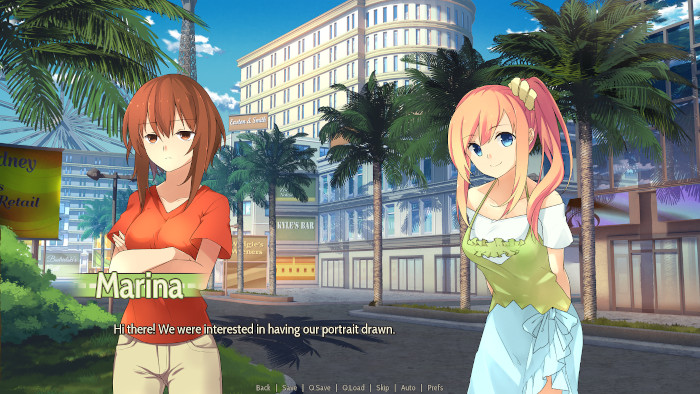
Amber and Marina in Vegas. These are the two sprites (with different facial expressions, poses and gestures) used through most of the game. (Credit: Studio Élan. Fair use.)
Amber and Marina grow closer during their adventure, and their blossoming love is the fluttering heart of the story. They do encounter other characters, chief among them a trio of treasure hunters led by a fierce and obnoxious woman named Mariah.
Tropes in America
In many ways, it feels more apt to compare Highway Blossoms with a romantic comedy movie than with a novel. The characterizations are over-the-top (Marina is the ditzy but angelic love interest sometimes found in rom-coms), and the presentation heavily relies on the capable voice acting by Katie Dagnen (Amber) and Jill Harris (Marina).
It’s all very cheesy, but it works, and you quickly forget that you’re not at the wheel at any point during this trip. The story features many notable sites—e.g., Shiprock, Canyon de Chelly, Arches National Park—which may inspire some players to make real world travel plans. The treasure hunt that motivates several of the stops gives parts of the story an unfortunate colonialist undertone.
The game features two erotic scenes between the main characters, which can be downloaded from the game’s website and added to censored editions. The scenes are part of the story and their inclusion feels neither forced nor gratuitous. In addition, the game includes extras such as “Marina’s Thoughts”, a gallery of small mementos from the story with Marina’s written comments on them.
The Verdict
While I found the graphics and parts of the soundtrack a bit repetitive, and some of the writing a bit cringey, I would overall recommend the experience if you’re in the mood for a wholesome love story. I would give Highway Blossoms 3.5 stars—rounded up because it made me both cry and laugh, as any romantic comedy should. There’s a continuation of the story called “Next Exit”, which I look forward to playing in future.