Latest reviews

Northway Games is a Canadian indie game development studio based in Vancouver, led by Sarah and Colin Northway. I Was a Teenage Exocolonist, released in 2022, is their most ambitious game to date.
They aptly describe it as a “narrative deckbuilding life sim”; it also incorporates elements of visual novels and dating sims. Playing with the I Was a Teenage Werewolf trope, the title winks at sci-fi pulp, but the story mostly plays it straight.
You are a crèche kid who was born in space during the twenty-year voyage of the Stratospheric to the planet Vertumna. After a preamble during which you can customize your character a bit, the game starts in earnest on the planet. Starting at age 10, you play until your character turns twenty; then you see an epilogue informed by your choices.
Named after the Roman god of seasons, Vertumna undergoes five seasons each year: Quiet, Pollen, Dry, Wet, and Glow. You make choices every month about which stats to raise through activities such as planting crops, learning engineering, or playing sportsball (sic!).
Before choosing your monthly activity, you can walk around the colony a bit. At first, you’re not allowed outside its walls; once you earn permission you can also explore the planet itself, where you advance through a set of events and encounters placed on the map. A stress score keeps you in check and has to be regularly lowered through relaxation.
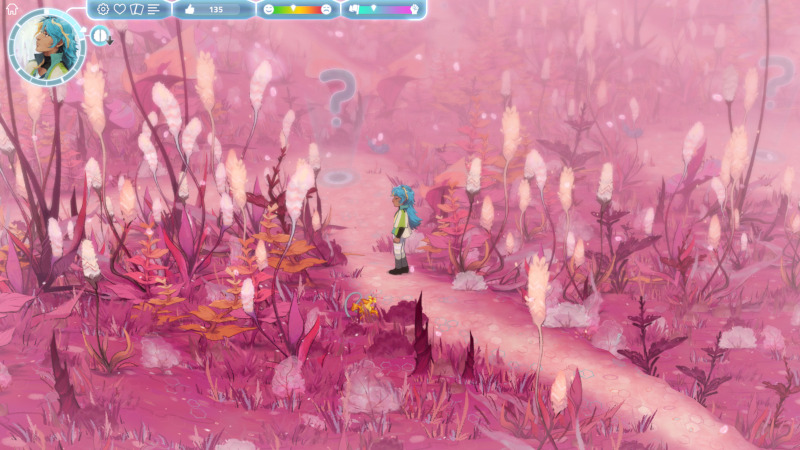
You explore the planet by walking a path that occasionally branches, progressing from one event to another. (Credit: Northway Games. Fair use.)
Interactive fiction with stats
The narrative plays out mainly in text and occasionally in large, static images. It’s driven both by who you talk to and what activities you choose, and by unavoidable key events. Vertumna is not quite Ceti Alpha V, but the planet’s flora and fauna is understandably not thrilled to be colonized and exploited, putting the settlers under constant threat.
When I say “mostly in text”, I should emphasize that there’s a fair bit of it. Even mundane events often get a paragraph or two of introductory text, and dialogue is written in the third person, like this:
Rex snorts and shakes his head. “Aw, nah, uh, this just happens sometimes, you know? After that whole fight with Vace, people got all these copycat ideas, you know, like, thinkin’ if they pushed me around a bit too, Vace would like them more.”
“People are like that sometimes,” he says, sagely. “They can be chill about hanging out in private, but around their friends, they don’t want anything to do with you. And if the bigger dog attacks, well, they wanna be on that puppy’s side, not yours.”
Rex shrugs one shoulder, indifferent. “It’s fine,” he says. “They’ll remember what I’m good at and come sneaking back eventually.”
This is in contrast with many visual novels, where dialogue is often shown next to a highlighted character. The longer form gives the story a bit more texture, but it may also give some players more reading fatigue; personally, I found myself skimming a bit, especially during low-stakes or no-stakes segments.
The choices available to you are constrained by your stats, which you raise with monthly activities. That means you’ll only see a particular slice of the game in one playthrough—e.g., if you max out engineering and organizing skills, you won’t see much of the branches related to combat.
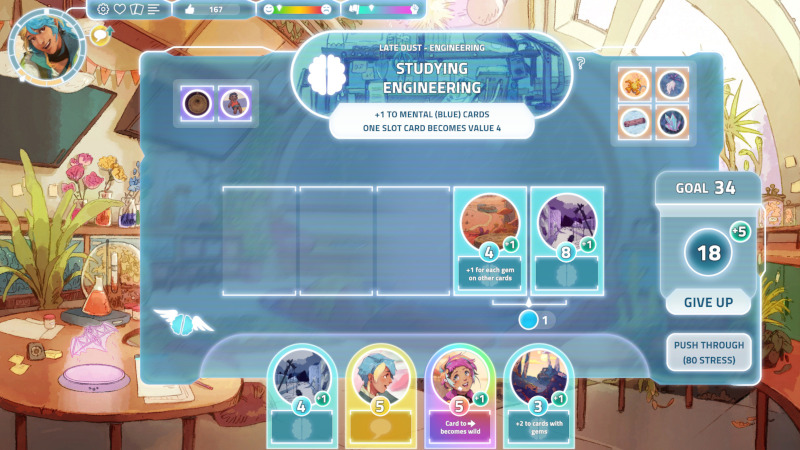
Although described as a deckbuilder, the card game has more in common with Poker than with “Slay the Spire”. You play without an opponent, and without the addictive challenges and combinatorics of something like “Balatro”. (Credit: Northway Games. Fair use.)
Deck and gear
Raising your stats and advancing through events often involves playing a short card game. There’s no opponent—you play a Poker-like game towards a target score. The game gives you the option to play in easy or hard mode. At least in easy mode, you can often still beat the mini-game by incurring a stress penalty.
To make things a bit more interesting, you can earn more points (kudos) if you hit the goal precisely. Kudos let you purchase “gear” cards, which you can equip to level up particular stats.
The combined mechanics are not terrifically well-explained (e.g., when you purchase gear, it doesn’t make it obvious how the “equip” mechanic works), but they do become clear over time. That’s somewhat consistent with the game’s expectation of repeated playthroughs.
Building a world
What makes I Was a Teenage Exocolonist truly special are not the mechanics, but the worldbuilding. Vertumna is beautifully drawn, and watching the planet change through the seasons greatly increases the immersion. The music is excellent and suits the game’s mood—slow-paced but suspenseful.
The planet’s lifeforms are described in rich detail, and there are many secrets to uncover if you’re willing to take risks. When the colony faces its first major crisis, you are there with them, hoping you survive—but you can’t be entirely sure, because people most certainly die in this game.
One of the most fascinating aspects of the game is the relationship of the colonists with Earth. Without giving anything away, suffice it to say that the exocolonists on the Stratospheric are a group with a cultural identity entirely of their own.
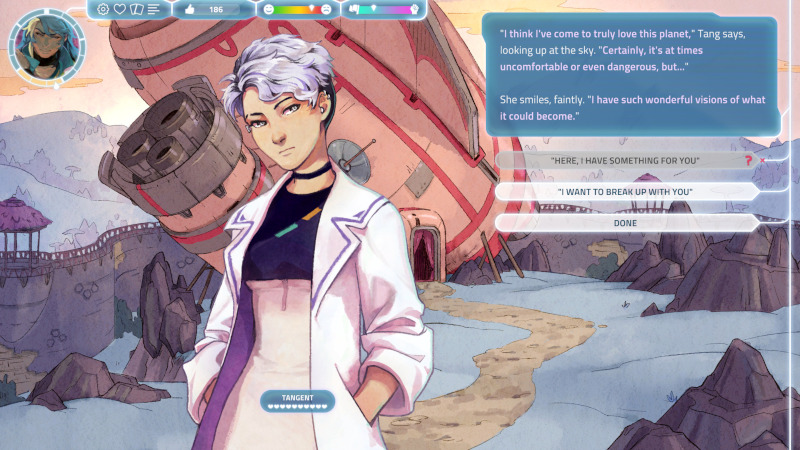
As you enter your later teenage years, you can attempt to date one of the other characters in the game. Even if things start out well, the game may still punch you in the gut later. This screenshot also highlights the stress mechanic—note the worn-down player avatar in the top left. (Credit: Northway Games. Fair use.)
Putting it all together
There’s so much evident labor of love in this game that I can’t help but give it five stars. But if I’m honest, it’s more of a 4.5, because not everything about it worked for me. There are three points of frustration I experienced playing it:
-
The gameplay loop in the colony is a bit tedious until you can go outside. For my next playthrough, I know to level up toughness and bravery early (which tends to involve sports or militaristic activities). Early on, it would have been nice to be able to join guided expeditions, or to get to know the planet in other ways.
-
The card game didn’t really “click” for me in the way that many deckbuilders have. The lack of an opponent and the limited combinatorics meant that I ended up mostly just advancing through these challenges as quickly as possible. I’m going to try again at the higher difficulty, but I was a little trepidatious to do so, because …
-
The stats system can be quite punishing. Choices are frequently unavailable to you based on your stats; even if you have spent many months of game time grinding a particular stat, it may not be quite high enough to do what you want to do. (At one point, I needed “persuasion at 100”, when it was “only” at 91.) There’s no “low chance of success”—the choice will just be locked.
So, mechanically, the game didn’t quite come together for me in the way I hoped. Lovers of dating sims should also be aware that the dating mechanics are fairly limited. They don’t influence the game much, and they don’t necessarily hold a promise of a “happily ever after”.
Still, I enjoyed my time on Vertumna enough to give it at least a second playthrough. I really do want to see what some of the other branches hold, what secrets I may have missed, and where I could have achieved a better outcome.
That’s why, ultimately, I highly recommend I Was a Teenage Exocolonist. If an immersive, text-heavy adventure on another world sounds appealing to you, you’re sure to get something out of it that will stay with you.
Ich abonniere die Katapult seit ca. 2 Jahren und genieße die Lektüre immer sehr! Sie widmen sich größtenteils politischen Themen, aufgelockert hier und da mit bissl Blödsinn. Das (meines Wissens) Einzigartige an der Katapult sind die ausgezeichneten Grafiken und Karten, die trockene Zahlen wirklich eingängig und leicht verständlich machen, und oft auch überraschen. So soll Datenjournalismus! Sie haben eine klare Ausrichtung pro Demokratie und Menschenrechte in der Auswahl ihrer Themen, was ich auch mehr als richtig finde. Ergänzt werden die Grafiken und Karten durch Analyse-Artikel mit wissenschaftlichem Hintergrund.
Zur Feier ihrer Expansion ins benachbarte Ladenlokal wollte ich ihnen hier mal eine Rezension widmen. Ein super Stoffladen mit sehr schönen Designs und einem umfangreichen Sortiment an Kurzwaren und Nähzubehör. Aber das beste ist das Team aus tw. schrägen Figuren, die eindeutig alle selbst viel nähen und wirklich Ahnung haben! Habe noch nicht versucht dort eine Nähmaschine zu kaufen (sie haben ein paar Ansichtsmodelle herumstehen), aber man kann seine Maschine auch halbwegs günstig dort zur Inspektion/Überholung abgeben.
Nicht vom übertrieben schicken Look des Ladens und der Angestellten abschrecken lassen, hier wird man freundlich bedient! Ich habe mein vorsintflutliches E-Bike hingebracht, als meine schlechten DIY-Reparaturen nicht mehr halfen. Sie haben es gut untersucht, mir alles sehr freundlich erklärt und das meiste gut repariert. Nur an einige Teile der veralteten Technologie wollten sie nicht ran, und wollten mir auch keine Gewährleistung geben, aber fair. Nicht ganz billig, aber die Online-Terminbuchung ist schon sehr praktisch.
Diese Bibliothek ist einer der zwei Standorte der Zentral- und Landesbibliothek Berlins (der andere ist die Amerika-Gedenkbibliothek am Hallenschen Tor). Fußläufig von der Ubahn-Station Museumsinsel, vom Humboldtforum und dem Roten Rathaus, ist dies ein wunderbarer und (noch) nicht überfüllter Ort zum Lesen, Studieren und Arbeiten. Neben einem großen Angebot an Zeitungen und Zeitschriften, einem kleinen und nicht überteuerten Café sowie gemütlichen Polsterstühlen mit Tischen gibt es auch einen großen Studiersaal sowie mehrere kleine Gruppenarbeitsräume. Dort gibt es akzeptables WLAN, viele Steckdosen und im Sommer ist alles klimatisiert. Interessant sind auch die simple aber elegante 60er-Jahre-Architektur und der Innenhof. Insgesamt einer meiner Lieblingsorte in Berlin!

Der Film F1 erweist sich als audiovisuelles Kraftpaket, das das Genre der Rennsportfilme technisch auf ein völlig neues Level hebt. Wer den Sport liebt, kommt hier voll auf seine Kosten, da der Film vor allem durch seine phänomenale Kameraarbeit besticht. Die Aufnahmen direkt aus dem Cockpit und unmittelbar vom Asphalt lassen den Zuschauer die enorme Geschwindigkeit und die physische Belastung der Fahrer fast am eigenen Leib spüren. Unterstützt wird diese visuelle Wucht durch ein exzellentes Sounddesign. Das Heulen der Motoren, das Kreischen der Reifen und die sonstigen Umgebungsgeräusche kommen kommen mit einer Surroundanlage am besten zur Geltung und sorgen dafür, dass eine absolut packende Atmosphäre entsteht.
Die Abläufe eines Rennwochenendes und die Dynamiken innerhalb des Fahrerlagers wirken zudem angenehm authentisch. Dennoch hat der Film kleine Schwächen in der Boxengasse: Die Handlung rund um den erfahrenen Veteranen, der ein junges Talent coacht, folgt sehr klassischen Hollywood-Mustern und setzt kaum neue Akzente. Im Mittelteil führt dies gelegentlich zu Längen, da die dramatischen Dialoge recht vorhersehbar bleiben.
Letztlich ist F1 zwar kein tiefgründiges Charakterdrama, aber als Erlebnis bleibt er ungeschlagen. Wer über die etwas klischeehafte Story hinwegsehen kann, erhält eines der intensivsten Kinoerlebnisse des Jahres.
Wer Mastodon nutzt, kennt das Problem: Die Standard-Weboberfläche ist funktional, wirkt aber oft überladen oder etwas altbacken. Hier kommt Phanpy ins Spiel – und es ist meiner Meinung nach nichts weniger als ein Gamechanger für das Fediverse.
Was macht Phanpy so besonders?
Das “Boosts Carousel”: Es ist eines meiner absoluten Lieblingsfeatures! Anstatt dass viele geteilte Beiträge hintereinander den Feed verstopfen, gruppiert Phanpy diese in einem eleganten, horizontalen Karussell. Das macht die Timeline unglaublich übersichtlich und rückt die Original-Beiträge der Leute, denen man folgt, wieder ins Rampenlicht.
Die “Catch-up”-Funktion: Wir alle kennen die FOMO. Die Catch-up-Funktion ist wie ein intelligenter Filter für die Zeit, in der man offline war. Sie präsentiert die Highlights in einem Interface, das eher an einen modernen E-Mail-Client erinnert – perfekt, um schnell den Überblick zu gewinnen, ohne endlos scrollen zu müssen.
Minimalismus mit Köpfchen: Phanpy nennt sich selbst “opinionated” (eigenwillig), und das im besten Sinne. Das Design ist extrem aufgeräumt, minimalistisch und fokussiert auf Lesbarkeit und Ästhetik. Es fühlt sich eher wie ein kuratierter Feed oder ein RSS-Reader an als wie ein klassischer Social Media Client.
Technische Brillanz: Als Web-App (PWA) fühlt es sich auf dem Smartphone fast wie eine native App an. Sie ist schnell, unterstützt mehrere Spalten für Power-User und bietet clevere Details wie das Einklappen von Hashtag-Wüsten.
Fazit: Phanpy ist für mich aktuell der Goldstandard unter den Mastodon-Clients. Es ist kostenlos, Open Source und beweist, dass man soziale Netzwerke auch ohne algorithmische Manipulation, dafür mit exzellentem User-Experience-Design, übersichtlich gestalten kann.
Wer Mastodon bisher “zu anstrengend” fand, sollte Phanpy unter phanpy.social unbedingt eine Chance geben. Ein riesiges Dankeschön an @cheeaun für dieses Meisterwerk!

In zweiter Reihe der Binnenalster liegt dieser Gasthof mitten in der Altstadt von Hamburg. Und diese gute Lage ist Fluch und Segen zugleich.
Durch die vielen umliegenden Firmen ist es mittags hier immer sehr voll und eine Reservierung ist ein Muss.
Die Speisekarte liest sich wie ein Kochbuch aus Omas Zeiten ist aber sehr schmackhaft.
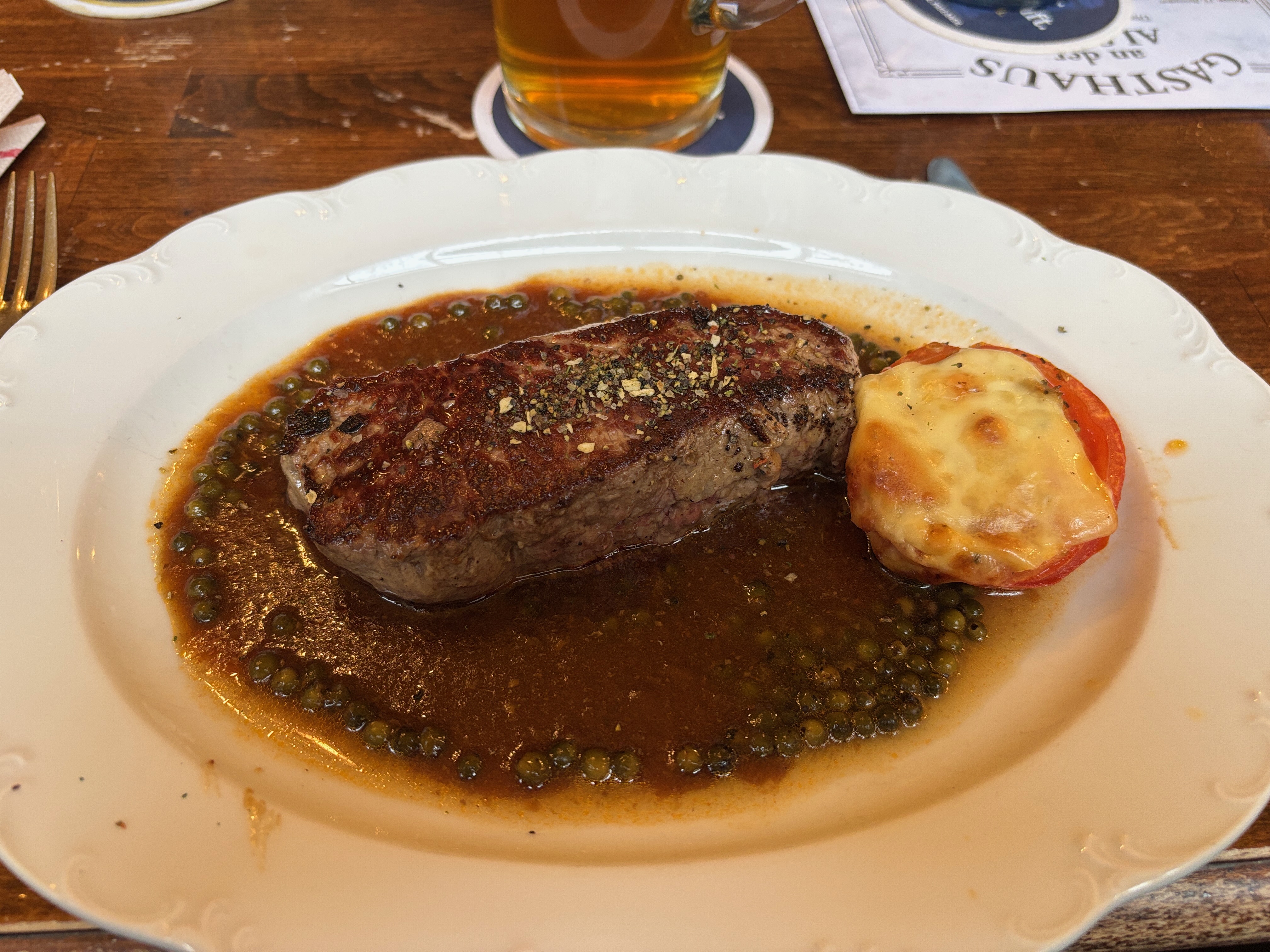
Steak Rosario im Gasthaus an der Alster in Hamburg (Eigenes Werk. Lizenz: CC-BY-SA.)
Durch ein paar seltsame Dekorationsartikel im Speiseraum wirkt der Laden für mich ein bisschen wie ein Touristenhotspot. Und man muss auch die bisweilen sehr hohe Lautstärke im Laden mögen.
I have been using this for almost 4 years now and it is working as advertised & expected. I have used it to inflate car tires (flat tire once), bicycle tires and a basket ball. It comes with adapter pin for different pin standards. I always carry this in my car and we can confidently depend on it. Battery backup is good, but one cannot inflate all 4 flat tires at once (this is an hypothetical case anyway).
Comes with an inbuilt LED flash light which will be helpful in dark places & the LED can also blink to alert vehicles from a distance. It comes with a USB-C charging port. No issues. I recommend this product.
I have been scouting for an affordable and quality wireless mic for vlogging & podcasting. My preferences include small form factor, mobile phone recording & good background noise reduction. There are easily affordable mics, budget friendly mics and costly mics. Hollyland as a brand has found a position in Indian market as a premium mic along with DJI and Rode.
One could see most of the popular Youtubers, use one of the above. Hollyland’s Lark A1 is a budget friendly and quality wireless microphone. It ticked all my preferences. Though, I have not yet used it extensively, so far it’s impressive. No regrets buying this. The form factor and the noise reduction are exceptional.
I would definitely recommend this to someone who wants to be a serious content creator.