
Reviews by Eloquence

The main focus of Hardcore Gaming 101’s “Retro Indie Games” book series are games that look, feel and/or play like old-school games from the 1980s and 1990s, but that are much more recent indie titles. (See my review of the first volume.)
The second volume covers both old titles that didn’t make the cut last time (e.g., Papers, Please! and Fez), and very recent games like Helltaker, Paradise Killer and Lair of the Clockwork God.
The format is largely the same as before: each game is richly illustrated and described in detail, with heavy focus on gameplay and story, and little emphasis on any other aspect such as the developers or how the game was made. As before, games are grouped by developer.
With 67 individual games, every reader with any appreciation for indie games is likely to discover at least one or two to add to their backlog. For me, that included Katana Zero (the time manipulation mechanic sounds super-interesting) and The Binding of Isaac (it just seems like a wild ride).
As with the first volume, I still feel the series could do better at being an actual guide to genres and developers. As an effort to catalog and describe some of the greatest retro-styled indie titles of the last decade or so, it is without equal.
The full list of games in the second volume follows (grouped by developer):
Cuphead
Celeste
Panzer Paladin
The Messenger
Cyber Shadow
Gunpoint
Aces Wild
Blazing Chrome
Katana Zero
Minit
Fight ‘n Rage
198X
Cave Story
Kero Blaster
La-Mulana (series)
Xeodrifter
Hollow Knight
Blasphemous
Iconoclasts
Dex
Rabi-Ribi
Pharaoh Rebirth
Touhou Luna Nights
Record of Lodoss War: Deedlit in Wonder Labyrinth
Fez
The Binding of Isaac
Dusk
Project Warlock
AMID EVIL
Cruelty Squad
Saturday Morning RPG
Cosmic Star Heroine
Anodyne
Anodyne 2: Return to Dust
Into the Breach
Chroma Squad
Katawa Shoujo
Digital: A Love Story
Don’t take it personally babe, it’s just not your story
Analogue: A Hate Story/Hate Plus
Ladykiller in a Bind
Broken Reality
Coffee Talk
Unavowed
Lamplight City
The Low Road
Ben There, Dan That!
Time Gentlemen, Please!
Lair of the Clockwork God
Paradise Killer
Return of the Obra Dinn
Umurangi Generation
Hypnospace Outlaw
Oxenfree
Back in 1995
Stories Untold
The Count Lucanor
Yuppie Psycho
Detention
Devotion
Paratopic
Anatomy
Papers, Please
Stardew Valley
Helltaker
As a twelve-year-old, Gwendy Peterson met a stranger who gave her a magical box that can destroy the world. That’s the premise of the Gwendy trilogy by Stephen King and Richard Chizmar.
The first book, Gwendy’s Button Box (review), was a fine story that stood on its own as a morality tale. The titular button box can fulfill wishes and wreak destruction—including at the planetary scale. As child custodian of the box, Gwendy used some of its powers, but was never corrupted by them.
In the mediocre sequel, Gwendy’s Magic Feather (review), Gwendy became a celebrated author and elected Congresswoman, and the box once more played an (ultimately anticlimactic) role in her life.
In Gwendy’s Final Task, the mysterious man or being who originally gave her the box tasks her to get rid of it once and for all. Because it’s a magical box, throwing it into a volcano won’t do. It must be…shot into space!
And so it is that Gwendy, now a Senator, finds herself on the way to a space station, with the button box locked away in a steel box marked “CLASSIFIED MATERIAL”. The spaceflight is organized by a SpaceX-style private company that is hoping to monetize space tourism.
That explains why one of the other passengers on board is an obnoxious billionaire. It doesn’t explain why the man seems to be completely obsessed by what’s in the steel box. Meanwhile, Gwendy is literally losing her mind to early onset Alzheimer’s disease.
The setup is ridiculous, but it mostly works. The enclosed environment, combined with Gwendy’s dwindling mental faculties, builds suspense. King rewards his constant readers with plenty of references to other works, including the Dark Tower series many consider his magnum opus.
The ending leaves no doubt that this truly is the final book in the series. That’s probably for the best. If you’ve made it to the second book, the conclusion is definitely an improvement, and I would recommend picking it up. If you’ve not started the trilogy yet, there are much better works in King’s oeuvre.

In the late 19th century, as the United States fully consolidated itself and its territory (through war and ethnic cleansing), its elites began to realize openly imperial ambitions. These ambitions reached a fever pitch in the Spanish-American War, which led to the US establishing control over Puerto Rico, the Philippines, Guam, and (nominally independent) Cuba.
When Smedley Butler, the son of an influential Pennsylvania family, joined the US Marines in 1898, he was caught up in the war fever of the time. But instead of fighting the Spanish, he soon found himself helping to police America’s empire on behalf of its most powerful economic interests.
Decades later, Butler, now a Major General, started to write his own script. In 1933, he alleged that he was invited to take part in a conspiracy among wealthy businessmen to overthrow U.S. President Roosevelt and install a dictator.
It became known as the Business Plot. A congressional committee concluded that “there is no question that these attempts were discussed, were planned, and might have been placed in execution when and if the financial backers deemed it expedient." Nobody was prosecuted.
In his final years, an increasingly radical Butler gave fiery speeches and penned a short book called War is a Racket. It contains the following passage:
I helped make Mexico, especially Tampico, safe for American oil interests in 1914. I helped make Haiti and Cuba a decent place for the National City Bank boys to collect revenues in. I helped in the raping of half a dozen Central American republics for the benefits of Wall Street.

Late in his life, Butler denounced war and empire, and fought for veterans’ rights. (Credit: Bettman/Getty Images. Fair use.)
Legacies of Empire
For American journalist Jonathan Katz, Butler’s life presents a lens through which to view the history of American imperialism, and its modern legacies. In Gangster of Capitalism, Katz traces Butler’s career in the military and his stint as Philadelphia’s “Director of Public Safety”, a role in which he waged a brutal war on crime in the city.
Katz makes it clear that Butler, in spite of his Quaker upbringing, committed truly horrific and violent actions, and often rationalized them through the pervasive racism of the time. As part of the nearly 20-year-long occupation of Haiti by the United States, Butler instituted de facto slavery to build up the country’s infrastructure.
Unlike the opaque Business Plot, the corporate interests that profited from these endeavors and drove US policies are well-documented, from bankers to landowners to oil companies. Franklin Roosevelt himself pursued personal agriculture investments in Haiti while helping direct its occupation as Assistant Secretary of the Navy.
In each chapter, Katz describes the modern legacy of American imperialism, including by quoting Haitians, Filipinos, Chinese, and others he has met. While Americans have forgotten the little they have ever known of this history, the citizens of these countries have not. Katz’s travelogue enriches the book and makes this history tangible.
Past and Prologue
Gangsters of Capitalism is an accessible, informative and engaging book. At no point does Katz turn from facts to polemic. He gives clear-eyed accounts of the brutal regime of Nicaragua’s leftist autocrat Daniel Ortega, and the imperialist ideology of China under Xi Jinping. The book is a critique of empire, not an anti-American screed.
It is also a timely book, as another imperialist power, Russia, wages a war of aggression against neighboring Ukraine. What role should Western powers play today to counter such naked brutality? Can military alliances like NATO protect the peace in the 21st century? What alternatives are there?
The invasion of Ukraine marks a new chapter in world history, and we all benefit from remembering previous chapters—including America’s own brutal imperial history—to navigate the moral landscape now before us.
Vampire Survivors by indie developer Luca “poncle” Galante was released in December 2021. It only costs $3 and is still in early access, but has already racked up tens of thousands of “overwhelmingly positive” reviews on Steam.
The game’s formula is simple but brilliantly executed, once you look past its rudimentary 16-bit style pixel graphics. Your goal is to survive for 30 minutes against ever-growing mobs of monsters. You start with a single weapon, but as you defeat monsters, you level up quickly. So far, that sounds like many twin-stick shooters.
The game-changing part of the Vampire Survivors formula is this: There’s no need for button-mashing, as your character auto-fires all weapons at their maximum firing rate.
As someone who quickly gets controller fatigue from many action games, I found it surprisingly chill to play, in spite of the amount of stuff happening on the screen. You avoid enemies, destroy them with an ever-growing arsenal of weapons, collect experience gems, and level up.
Power-ups from hell
Level up enough, and the game’s promise that “you are the bullet hell” becomes fulfilled. It’s hard to convey just how insane things can get. Consider that this shows only a mid-level build:
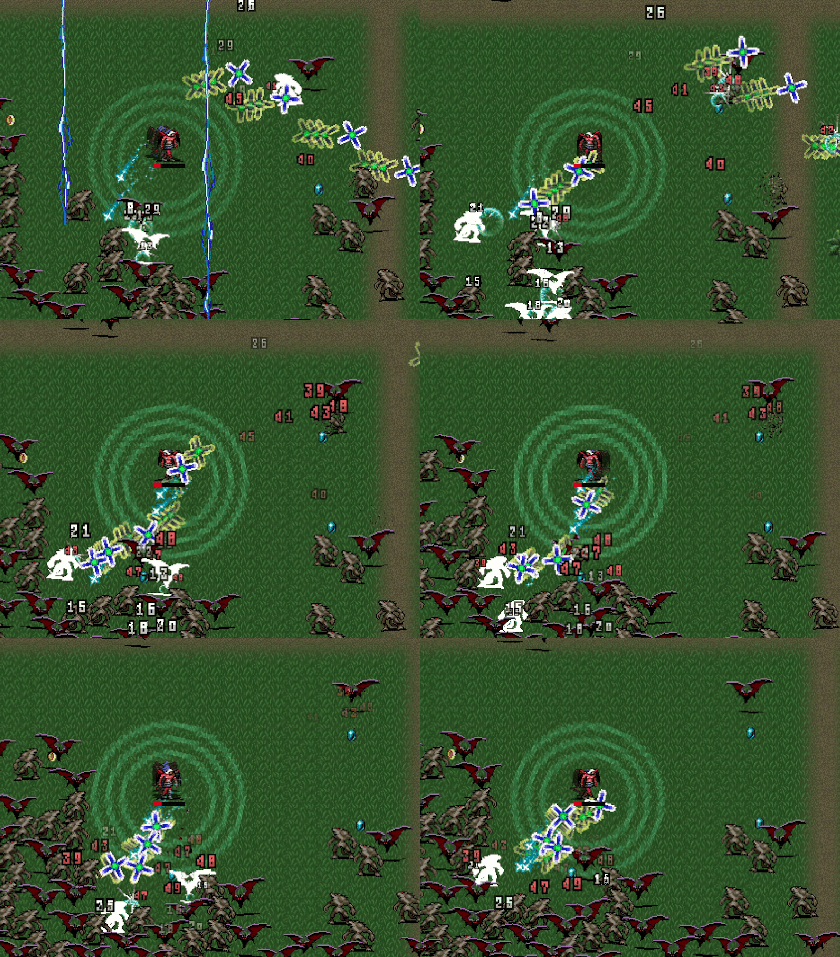
Character “Krochi” facing an onslaught of monsters in the first stage. (Credit: Luca Galante. Fair use.)
To make it through 30 minutes, you need to continually improve your build, and combine items into ultra-powerful “evolved” weapons. You can also use collected coins from a run to buy persistent power-ups that will help you with all future runs.
It won’t take you more than a few hours to master the first stage, but Vampire Survivors has lots more to offer. You can unlock many different characters (who may have their own unique weapons), additional stages, and additional difficulty levels.
While the maps are generally super-simple, there are a few surprises. For example, the “Dairy Plant” map features new mechanics, such as little carts you can push in the direction of oncoming enemies, and special floor tiles that trigger enemy waves to spawn.
Challenging but not limitless
Even though it is still in early access, Vampire Survivors easily offers 10-20 hours of frantic play as of this writing; content updates have been forthcoming at a rapid clip. If you like action games and don’t find the visual intensity offputting (or worse), you’ll definitely want to check it out.
Unlike roguelikes that offer nearly endless challenges, most players will eventually hit a ceiling as they accumulate persistent power-ups and develop ever-more successful builds. But for $3, that’s still a hell of a lot of entertainment (no pun intended), and anyone trying the game now should revisit it again in a few months as it continues to be expanded and balanced.
I played Vampire Survivors on Linux using Proton without issues (I did have to set the launch options to PROTON_LOG=1 %command% as recommended on ProtonDB).
Additional reading
-
In February, NME published a nice interview with developer Luca Galante.
-
As usual, a Fandom wiki has quickly popped up; if you don’t want to discover every combo for yourself, the weapons evolution guide in particular is indispensable.
What if you took some of the best ideas from the roguelike deck-building genre, but instead of being dealt cards, you rolled dice on each turn? That’s the premise of a ridiculous, addictive, and sometimes frustrating game called Dicey Dungeons.
Developer Terry Cavanagh has published indie games since at least 2008, but his breakthrough titles were the puzzle platformer VVVVVV (2010) and the brilliant twitch game Super Hexagon (2012).
When I first looked at Dicey Dungeons, I was not especially enamored. Anthropomorphized dice, really? The moment you start actually playing it, the game’s self-aware sense of humor makes it all work.
You play as the contestant in a gameshow whose host, Lady Luck, promises to fulfill your innermost desires if you win. The catch? You’re transformed into a dice and are doomed to compete in Lady Lucks’s dungeons forever, with the game clearly rigged against you.
Revenge of the bloodsucking vacuum cleaners
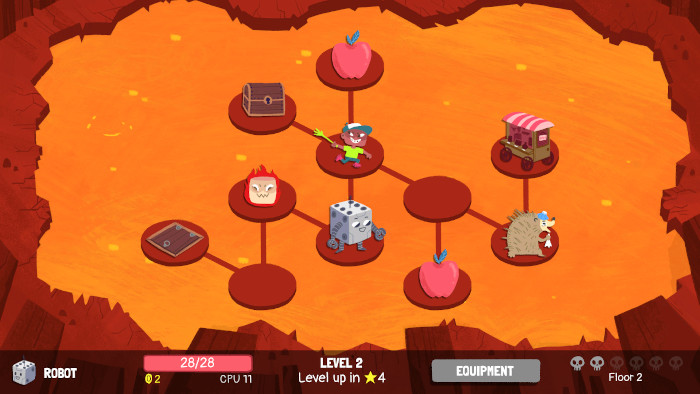
The maps are the least interesting part of the game, but they do show you all the enemies you can fight in a given level. In this case, you can go up against a marshmallow, a coin-stealing kid, and a sickly hedgehog. (Credit: Terry Cavanagh. Fair use.)
The enemies you encounter are not the standard fantasy fare. Instead, your next opponent could be a bloodsucking vacuum cleaner, a snowball-throwing yeti, a poisonous ice cream cone, or a guy whose entire head is a home stereo system.
Battles are turn-based. On each turn, you roll a number of dice, which you then drag and drop to a compatible item in your inventory. You may not have one! For example, all your items might require even numbers, and you might roll a bunch of threes.
It’s a simple enough concept, but with a large variety of enemies and items, it adds up to a rich gameplay experience. By itself, that could make for a 5-10 hour game. What makes Dicey Dungeons a 30-60 hour game is its willingness to throw its own rules by the wayside.
Rules, schmules
As you play the game, you unlock new characters with their own sets of items, and with completely different play styles. For example:
-
a character that casts spells from a spellbook with a fixed number of slots, of which up to four can be active at any given time.
-
a character that, instead of rolling dice, generates random numbers towards a fixed target value. If you hit that target value exactly, you get a jackpot reward.
-
a character that is dealt a set of cards in random order, combining true deckbuilding mechanics with dice.
Moreover, each character advances through six episodes that play with rules in interesting ways. The most interesting of these are the “parallel universe” episodes (in which items and status effects work completely differently) and the bonus episodes (in which you gradually accumulate randomized rules like “after 4 turns, all enemies transform into bears”).
It all culminates in a final confrontation which, again, does something completely new and interesting with the game mechanics. I won’t spoil it for you; suffice it to say that there’s a lot to keep the player engaged. And when you’re done with that, there are some (fairly easy) Halloween bonus episodes as well.
As with Super Hexagon, Cavanagh again collaborated with Chipzel on the music. Unlike the high octane chiptune sound of Super Hexagon, Dicey Dungeons’ soundtrack blends in jazzy flavors, which give the game a unique feel.
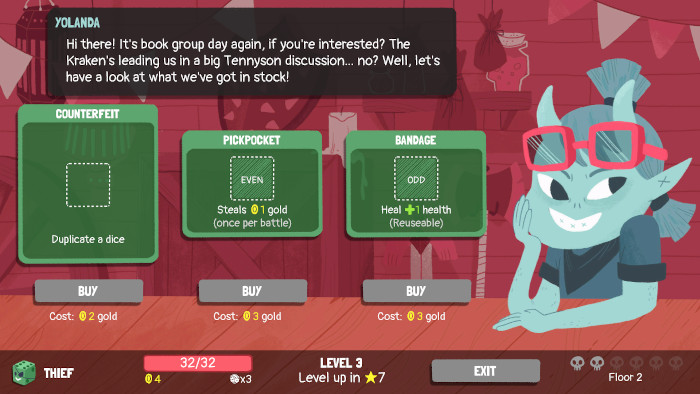
The game’s wit and humor come through in many places, such as when visiting shops. Sometimes the shopkeepers will even remark on specific enemies in the level you’re in. (Credit: Terry Cavanagh. Fair use.)
Dice with rough edges
The game is not perfect. My criticisms of it can be summed up in three categories:
-
Pointless maps: The game features suitably atmospheric levels such as “the libary” or “the dark forest”. But the actual dungeon maps are extremely linear and basic. The most complex choices you’ll make navigating the dungeon are branching questions: This enemy first, or that one?
-
Luck over strategy: Being at its heart a dice game, Dicey Dungeons can be incredibly unfair. An enemy can roll two sixes twice in a row, hitting you with maximum damage and status effects, while you are barely able to make a dent due to a poor roll.
In theory, you can sometimes flee a battle. But that action is almost useless. You’ll still have all your damage, and in many cases you won’t progress unless you defeat the enemy. So, go against the same enemy again with three hit points left, while they’re back at full strength? Good luck! -
Inconsistent execution quality. The spellbook user experience, for example, is very clunky—the drag and drop mechanics are poorly explained and not intuitive. Even though the mechanic had promise, I had the least fun playing that character, just due to the interface feeling so unpolished.
Each character’s list of episodes includes an “elimination round” which, as the name suggests, exists to prevent straightforward progression. It achieves this by making the enemies’ items a lot more powerful. Unfortunately, this can lead to a high number of unwinnable encounters.
The Verdict
Those criticisms shouldn’t distract from the fact that Dicey Dungeons, overall, is a hell of a lot of fun to play. There’s a lot of love in the details, from the silly unlockable enemy biographies, to the clever dialogue during encounters or shopkeeper visits.
I would give the game 4.5 stars, rounded up because of the sheer amount of gameplay variety and content. If you enjoy the deckbuilding formula, and are looking for something similar that may keep you entertained for a few weekends, go and roll those dice—you might get lucky!
The explosion of indie gaming in the 2010s has blessed players with the triumphant return of genres largely written off by major publishers, from 16-bit-style “metroidvanias” to point-and-click adventures. The flip side of this blessing is the problem of discovering the indie gems you truly want to play. That’s where Hardcore Gaming 101’s Guide to Retro Indie Games comes in.
On 152 richly illustrated pages, the first volume presents detailed overviews of many games which, while mostly released in the 2010s, seemed “retro-styled” to the editors. It is, as they acknowledge, a squishy definition:
It’s primarily to refer to games that would be inviting to fans of classic video games, rather than a specific style. For example, even though Night in the Woods doesn’t have a pixel look, it’s still recommended for adventure game aficionados.
To be sure, you won’t find on these pages the kinds of indie games that are going head-to-head against big-budget, “triple A” open world RPGs or first-person-shooters. If there is going to be a shooter, it’ll be a “boomer shooter” in the style of the original 1990s trailblazers like Doom or Duke Nukem.
Straight to the point
The guide focuses on gameplay above all else. Don’t look to this volume for information about the developers, how the games were made, or technical details. The tiny infobox about each game contains its title, the year it was published, and the platforms it’s on—that’s it.
The platform list at least is exhaustive, condensed into three letter abbreviations ranging from the obvious (“WIN”, "PS4”) to the obscure (“AFT”, “PAN”). Thankfully, there’s a system key on the first page.
Each article is somewhere between a review and an overview, and seems intended to help the reader answer two questions: How good is it, really? And, is this game for me?
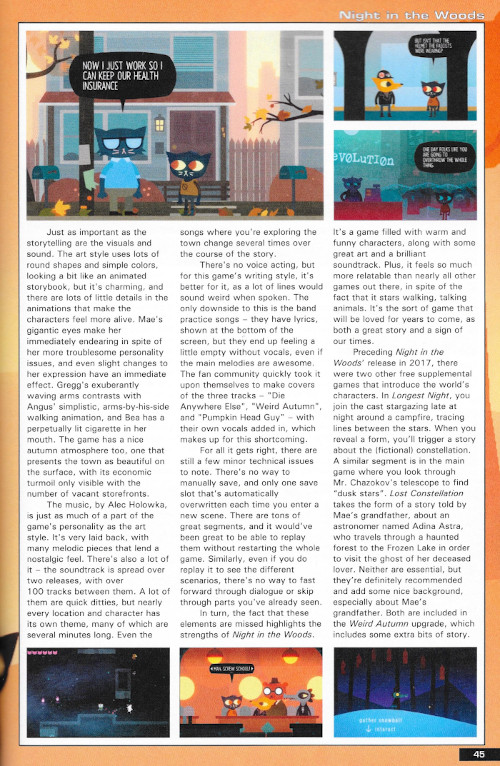
Games are typically described in two pages, and every single page is richly illustrated. (Credit: Hardcode Gaming 101. Fair use.)
On the whole, I found the articles fair and informative, helping me prioritize my backlog and discover some new games. In a couple of cases, the articles went a little too close to spoiler territory for my liking, but that can be hard to avoid when writing about a story-driven game like Lisa or Undertale over multiple pages.
Not a true guide, but still a great introduction
To be truly a guide rather than a collection of articles, the Guide to Retro Indie Games would have benefited from some chapter introductions to the developers or the genres represented here. Nonetheless, if you love indie games and enjoy reading about them in print, I definitely recommend it.
One caveat: the first copy I ordered had severe print quality issues. That kind of thing happens especially with small publications, and Amazon quickly sent a free replacement, so it’s not reflected in the review score. I also bought the second volume, which did not have the issue.
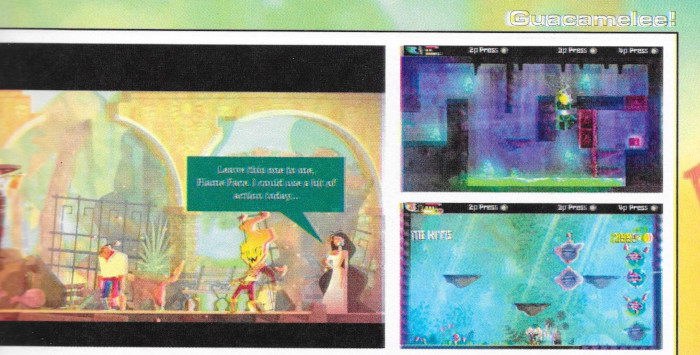
The first printed copy I ordered from Amazon had significant color misalignment issues on every page, rendering the screenshots blurry and almost unreadable. (Credit: Hardcode Gaming 101. Fair use.)
The full list of games in the first volume follows (grouped by publisher):
The Shivah
The Blackwell Series
Gemini Rue
Resonance
Primordia
Technobabylon
Shardlight
Kathy Rain
Thimbleweed Park
Nelly Cootalot
Always Sometimes Monsters
Read Only Memories
Va-11 Halla
Night in the Woods
Pony Island
Mercenary Kings
Flinthook
Odallus
Oniken
Noitu Love
Rogue Legacy
Super Time Force
Volgarr the Viking
Freedom Planet
Westerado
VVVVVV
Shovel Knight
Super Meat Boy
Ultionus
Mystik Belle
Guacamelee!
Axiom Verge
Owlboy
Dust: An Elysian Tail
Hyper Light Drifter
Alwa’s Awakening
Undertale
Lisa
Barkley, Shut Up and Jam: Gaiden
Severed
One Finger Death Punch
Not a Hero
Assault Android Cactus
Hotline Miami
Crimzon Clover
Blue Revolver
Hydorah
l’Abbaye des Morts
Maldita Castilla
The Curse of Issyos
Cardinal Cross is a choice-driven visual novel about a space-traveling scavenger named Lana Brice, who unexpectedly finds herself caught up in a galactic conflict of an astrological nature. The game was written by Roman Alkan and published through her small indie studio LarkyLabs under its ImpQueen brand.
In this universe, predictions derived from the movement and position of celestial objects are as fictionally real as the Force in Stars Wars, or as the fungal excretions of sandworm larvae that make interstellar travel possible in Dune. In most other ways, Cardinal Cross employs familiar sci-fi tropes: cybernetic implants, space rebels, robots and AI, the works.

Lana Brice (left) is a space scavenger with strained family ties. (Credit: LarkyLabs. Fair use.)
Meet the factions
Lana Brice and her friend Wiz, the Mechanic, are part of group of planets known as the Raiders. These folks have gotten the short end of the stick in a conflict with another group known as the Morai System, and they’re generally treated like colonies.
In a black market transaction, Lana and Wiz come in contact with a rogue intelligence agent of the Morai, who is trying to purchase an artifact from them. Most people have cybernetic implants, but this guy is enhanced to the point of almost losing his humanity. He is dangerous, and so are his former employers.
Soon enough, Lana is caught up in a web of conspiracies and plots involving multiple factions. At its center is an astrological supercomputer which the Morai elite use to maintain power and control. Its predictions are not perfect: so-called “howlers”—some humans, objects, planets—elude it completely. (I’m guessing the term is a reference to errors and aberrations rather than monkeys.)
As you might expect from its astrological theme, much of the story revolves around whether our fates are our own to write if the stars seem to already foretell what they are. Thankfully, the story never gets bogged down in sophomoric arguments about free will—it plays out more viscerally through Lana’s choices. That is to say, your choices.
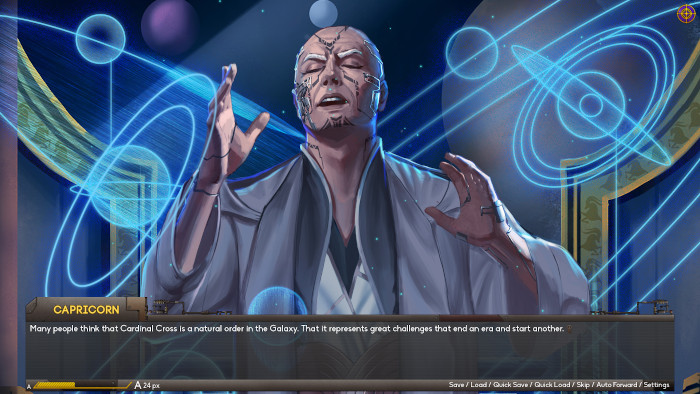
One way or another, Lana’s fate is in the stars. (Credit: LarkyLabs. Fair use.)
Choices and characters
Throughout the story, you get to make more than 100 decisions, typically about things to say, sometimes about things to do. A lot of them have a negligible effect, but you can romance three different characters, influence Lana’s personality, and achieve multiple endings.
The game signals the most important choices with a sound effect, and it makes it clear when you have the option to embark on a romantic adventure. It also displays the effect you have on others (“[name] is annoyed”, “[name] is amused”). These messages are sometimes off-point and immersion-breaking, but you can disable them entirely.
Cardinal Cross is not voice-acted, but it is exceptionally well-illustrated. Not only does it have beautiful character art, it has a ton of it.
There are 50+ side characters, and most of them are visually well-differentiated. It includes 70+ full-screen graphics during special events (“CGs” in visual novel lingo). In case you’re wondering: the graphics for the romantic outcomes are about as tame as what you’d find in a PG-rated movie.
The game has a soundtrack by Jeaniro, which creates suitable ambience without distracting from your reading experience. During the story’s most dramatic moments, the music becomes boisterous or tense, generally fitting the text well.
The story is substantive, but it doesn’t overstay its welcome. I reached an ending which suited my choices well in about 6 hours. After I checked out one other ending with the help of a guide, my total playtime added up to 8 hours.
A good yarn with a few flaws
Roman Alkan’s world-building helps to set the stage effectively, even if the introduction of the in-universe terminology is a bit tedious at first. I had three main issues with the writing:
-
It would have benefited from more editing (there’s some dialogue that’s a bit awkward; there are a few spelling/grammar issues throughout).
-
There are too many characters to keep track of, and the story shifts too quickly between them.
-
Relatedly, the story doesn’t give enough space to some key dramatic moments for us to really grapple with what just happened.
Know that it’s a violent game. Both Lana and the other characters may hurt—and kill—people they come across. Cardinal Cross does not explore its darker themes with the same sensitivity some visual novel writers (like Christine Love) bring to their work; here, transgressions don’t always have the reverberations you would expect.
All in all, though, it’s a good yarn. It riffs on the astrology theme in a way that I’ve personally not encountered in sci-fi (astrology is still annoying, don’t @ me!). It’s a great example of the art form, bringing graphics, music and writing together into a coherent whole. I would enjoy reading about the further adventures of Lana Brice, and will definitely pay attention to ImpQueen’s future works.
As if Aidan didn’t already have his hands full! Now his father has gone missing. The single, unemployed dad of a highly energetic little daughter is barely out of bed when he begins to discover the first clues in his father’s workshop as to what may have happened.
What on Earth is “Clonfira”, and what do the strange patterns on the wall mean? Suffice it to say that Aidan’s father has discovered a way to visit another world, and Aidan and his daughter will soon follow in his footsteps.
The Little Acre by Irish indie developer Pewter Games is a point-and-click adventure. The game’s credentials are boosted by Executive Producer Charles Cecil, a grandmaster of the genre (Lure of the Temptress, Broken Sword).
Worlds brought to life
You play as Aidan and as his daughter Lily. The controls are as simple as it gets: you click on hotspots and sometimes combine items in your inventory with what’s currently on the screen. Many puzzles are contained within a single scene, keeping typical point-and-click frustrations (backtracking, a large inventory) to a minimum.
Most puzzles make sense at least in retrospect, even if you sometimes have to behave nonsensically to progress (scare a cat → cat smashes flower pot → smashed flower pot reveals hidden item you need). Built-in hints may help if you do get stuck.
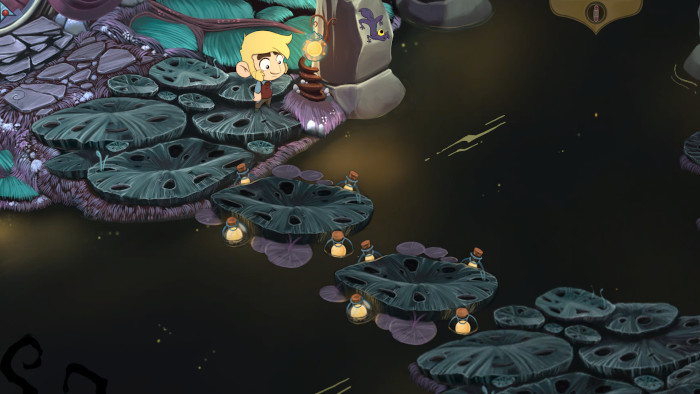
Once Aidan enters the alternative dimension where his father may have gone missing, he transforms into a chibi (small and cute) version of himself. (Credit: Pewter Game Studios. Fair use.)
The game’s worlds are brought to life in excellent art and animation. Whenever you solve a puzzle, you’re likely to see a fully animated little scene. Even when you’re not doing anything, much of the game is visually captivating, and the world feels alive. Some cut scenes are almost of cinematic quality.
The game’s music is catchy and enjoyable, albeit a bit repetitive. The Little Acre is fully voice-acted as well. For some reason, the two main characters narrate their actions in the past tense, which doesn’t always make sense. There are no dialog trees and few interactions between characters.
A rushed adventure
It’s all over very quickly: a full playthrough is likely to take you between 1-2 hours. Some adventure games manage to deliver a powerful experience in a short playtime (think Loom or the more recent What Remains of Edith Finch). The Little Acre unfortunately feels very rushed.
Scenes that should have emotional power aren’t given the room they need. The villain’s motivations are insufficiently explained. A new character is introduced but given very little to do. Switches between Aidan and Lily happen too quickly. The ending is abrupt and delivers limited emotional payoff.
At the same time, the game’s amusing animations, cutely drawn characters, and relative simplicity make it a good family activity, if you don’t mind that it also deals with grief and loss. Kids may be more ready to forgive the game’s weaknesses, and to fill in the blanks with their own imagination.
Overall I would give The Little Acre 3.5 stars, rounded up because Dougal the dog is a very good boy. It’s often on sale for $5 or less, and that’s a good price to pay for it.
Technical notes:
The game has a native Linux version. It crashed for me a couple of times, but auto-saved at the beginning of each scene, so I did not lose any progress.

To the Moon (2011) is one of the most beloved indie narrative adventure games of all time. In it, two scientists travel into a dying man’s memories to fulfill his final wish. Into A Dream (2020), created by solo developer Filipe F. Thomaz, has a similar premise.
You play a man named John Stevens who finds himself in the dream world of another man, Luke Williams. Luke appears to be experiencing a mental health crisis, and you receive a message from the outside world tasking you with investigating its origins.
One of the unfortunate side effects of the dream insertion procedure is that John doesn’t have access to his own memories. So, just like the player, he knows nothing about the people he meets or the specifics of Luke’s life. John meets him and his family at different points in their lives.
Luke, it turns out, is an entrepreneur who is pursuing a vision of ubiquitous renewable energy. Exhausted by work, he reaches his breaking point after the early death of his mother. His wife Rita and his daughter Anne pay the price as Luke grows increasingly distant from them.
Platforms in the way
You view the dream world from its side, and everything is rendered in silhouette, as in a shadow play. As is typical for narrative adventure games, you spend a lot of time talking to characters you meet. The game also has simple platformer sequences (jump & climb), inventory fetch quests, and one puzzle that depends on precise timing.
The game’s action sequences and puzzles are rarely clever or original—they serve as speedbumps that prevent you from rushing through the story. Into A Dream lacks the qualities that make a great platformer (quick animations, optimized hit zones, responsive controls), so this is the single most frustrating aspect of play. Fortunately, you can’t die permanently, and you can save and resume anywhere.
Into A Dream makes excellent use of changing background colors, lighting, and other effects to convey the sense of an unstable yet beautiful inner world. The game is accompanied by Thomaz’ piano music, which suits the game’s atmosphere well. The presentation falls short in other ways.

When it doesn’t get in its own way, the game depicts a world that is suitably dreamlike, at times serene and beautiful, at times shockingly unstable. (Credit: Filipe F. Thomaz. Fair use.)
Inconsistent execution
Close-up views of objects (such as a children’s doll or a tombstone) look amateurish. Characters you meet are only rendered in one or two poses. For example, you’ll always encounter Luke’s wife sitting cross-legged or talking on the phone.
Animation is in short supply, too. Nobody other than you ever moves around—they just dissolve when a scene ends. The presentation gets in the way of the gameplay when you have to figure out what to do next: Where’s the exit? What’s that black object in the foreground? Can I interact with that door?
The game is fully voice acted by a diverse cast, at varying levels of quality: sometimes energetic, sometimes inaudible, sometimes overwrought or cartoonish. Given the game’s tiny budget (it raised less than $3,000 in an Indiegogo campaign), it would be unkind to be too critical here.
I found the story engaging, and the writing is generally good. There are a few spelling and grammar errors that could have been caught (such as the repeated spelling “murdured” instead of “murdered”), and a simplistic heaven/hell theme in the late game that distracts from the main story.
The Verdict
Into A Dream immerses the player in a world that is at times tantalizingly beautiful, but it frustrates them with clunky platformer sequences and immersion-breaking inconsistencies in its presentation. For a work mainly driven by a single developer, it’s an impressive achievement regardless, and I’ll certainly be interested in Thomaz’ future work.
I wouldn’t recommend Into A Dream at its full price of $15, but discounted below $5 it’s an interesting enough experience over 3 hours or so, if you’re willing to forgive its more frustrating parts. 3.5 stars, rounded down because of one especially annoying stealth sequence in the late game.
Titles like Spiritfarer and Grimm’s Hollow show that imagined afterlives can have immense storytelling power as interactive game experiences. What Comes After by Rolling Glory Jam offers a similar, much shorter fantasy.
You play a young woman named Vivi who falls asleep on the train. When she awakens, she discovers that the train is now filled with spirits destined for “what comes after”. Is she dead? And if not, can the spirits on the train offer her any useful guidance?
The game is structured as a side-scroller, but offers no real choices or challenges. You talk to the beings on the train and move in different directions—that’s it. The whole experience takes about an hour.
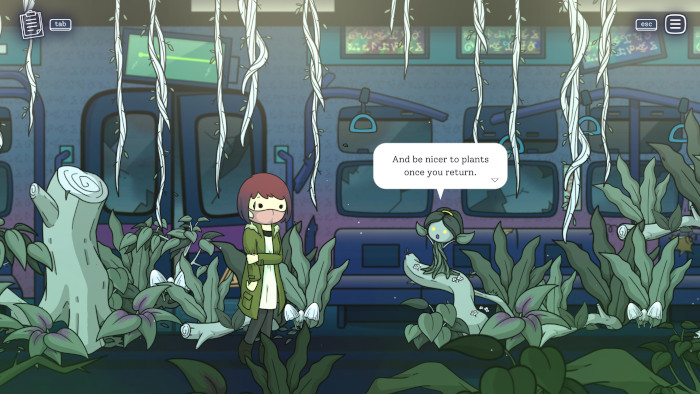
Be nice to your houseplants or they’ll lecture you later. (Credit: Rolling Glory Jam / fahmitsu. Fair use.)
That means that the quality of the writing is paramount. Unfortunately, this is where What Comes After falls short. The spirits you talk to share a few sentences about their lives, and may dispense brief platitudes like “Live your life as you see fit and cherish the good people around you.”
Vivi, it is revealed, has struggled with depression and suicidal ideation. These are difficult subjects to tackle, and the game does not do them justice with its fortune cookie wisdom.
What Comes After does offer a couple of sweet moments. You hear the stories of several animals, for example, and encounter a mystical chef who serves very special treats. Some scenes are beautifully illustrated (other scenes are very visually repetitive).
Overall, while it’s clearly a labor of love by a talented team of indie developers, this is one trip to the great beyond you can sit out.