Latest reviews

tl;dr – Great vegan options, but tv screens and music might distract you if you’re sensitive
We visited The Botanic – that is, the restaurant part, not the bar – on a sunday noon (reservations recommended) specifically because they offer a vegan version of the Irish classic ‘sunday roast’ menue. This one uses seitan slices as roast, which tasted amazing. The gravy served with the menue also deserves to be pointed out, as it was among the best I ever tried. There were also several sides included (carrots, cabbage, broccoli, potatoes and onion stuffing). All in all an amazing menue that probably serves one hungry adult or two not-so-hungry ones for ~18€.
The black tea and hot chocolate were prepared with oat milk on request and were also very tasty (milk is included with the tea by default). 2€ for a cup of tea is a steal in Dublin city. Nothing to complain here!
The downside with this location for me specifically is with the ambiance. Whilst the place is lovingly decorated, they clearly want to appeal to audiences that expect to watch sports events. In the main room, there are 10+ large TV screens (at the time of our visit, showing advertisements and motor racing). They did not play the TV sound on the speakers, yet I found the music slightly too loud, although this may vary. If you are sensitive to distractions, I recommend you ask for a table near the windows or in the back, where there are alcoves and the music is a little more quiet. The staff happily reseated us spontaneously and were generally very friendly and helpful!
All in all, The Botanic is an amazing place for a lively meeting of small and large groups, especially for vegans and omnis to get together. Bonus points for sports lovers. Looking for a quiet place to converse or read, you’d rather go somewhere else.

Roguelike deckbuilders are one of my favorite indie gaming genres. Definitive titles like Slay the Spire (review) offer 100+ hours of replay value as you explore their combinatorial depths.
Roguebook came out in the summer of 2021 and was developed by Belgian studio Abrakam. The game’s premise is that the playable characters are trapped inside the eponymous book, and must fight their way out using cards.
That book metaphor shows up in a few places: the overworld is mapped out using ink and paintbrushes, and you collect pages to unlock meta-progression between runs.
But it’s a shallow conceit, and the world is a very run-off-the-mill, generic fantasy world you’ve seen a million times; the name “Faeria” tells you everything you need to know. There’s no real narrative beyond “we’re in a book!”. The brief character bios are mostly about their skillset, and intermittent “story” moments are isolated and non-specific. Even Slay the Spire, not known for its story, does a better job connecting its atmosphere and lore.
Still, there are a few things to like about Roguebook, starting with the overworld.
Echoes of Might and Magic
Maps tend to be the genre’s Achilles heel: usually you just wander one of two or three pre-defined paths and pick which monsters to fight. The worst offender may be Dicey Dungeons (review), an otherwise excellent game: the level maps are glorified interstitials that show you which battles lie ahead.
Before Roguebook, the best maps I’ve seen are the ones in Across the Obelisk, which offer interesting branches and fast travel, and are beautifully designed. But the maps are static images overlaid with random events. Not very roguelike!
In contrast, Roguebook’s overworld is a randomly generated multi-screen hexagon map you travel across. You gradually reveal it using brushes and ink you earn from battles or as part of other rewards. Loot and enemies are scatted across the map. Many battles are entirely optional if you just want to go for the boss.

Yes, that is a turtle flying on a magic carpet. (Credit: Abrakam. Fair use.)
The level-specific buildings, terrain and vegetation give the overworld a much more lived-in feeling than what you can expect from most deckbuilders. It feels just a tiny bit like the gorgeous maps in a beloved game like Heroes of Might and Magic. But I don’t want to exaggerate — the amount of “stuff” that happens on these maps is much more limited.
Still, it’s undeniably more fun to crawl these maps than it is to pick a path in Slay the Spire. There’s loot everywhere, there are towers and runes that reveal more tiles and treasures, and the scarcity of ink forces you to prioritize. As shown in the screenshot, you’ll usually only see parts of the map before progressing to the next level.
Tag Team Battles
Once you’re in a battle, it looks like any other roguelike deckbuilder: player characters on the left, enemies on the right, cards at the bottom, along with your draw pile, discard pile, and dissolve pile.
There are, of course, a few specifics. You’re always in a tag team. When you start a run, you get to choose two heroes from a total unlockable set of four (one more available as DLC). There are some nice touches here: the game has a bit of flavor speech for each hero and for the interactions between your pair. It’s not much, but it shows an attention to detail that lifts the game above feeling like a genre clone.
Defense points are shared across heroes, which keeps things simple. The position (front or back) does matter (e.g., front hero takes damage first), and quite a few mechanics are tied to hero position. For example, one card powers up every time you switch positions, which can make it extremely powerful in a long battle.
In addition, heroes can recruit “allies”. When I first drew a card called “Windstorm Colossus”, I was hoping for a dramatic addition to the gameplay:
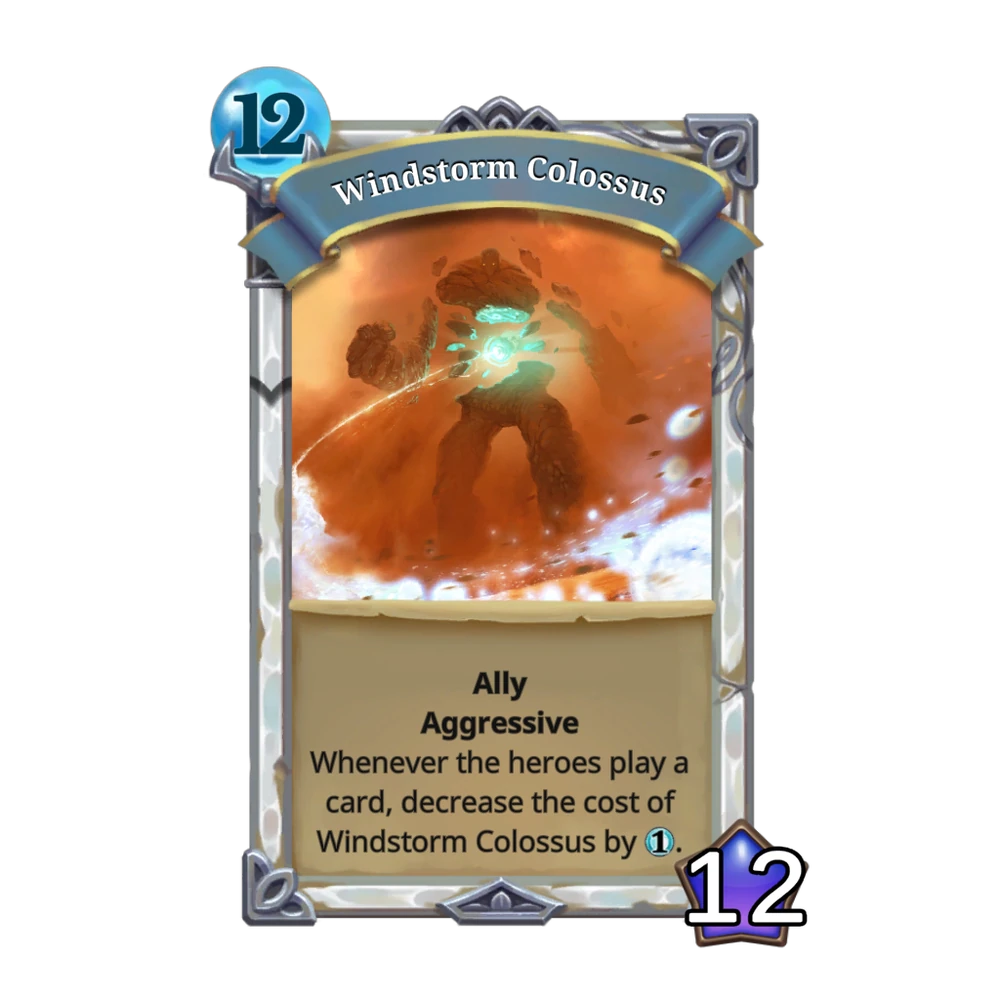 Alas, once you play them, allies just show up as unmoving, barely discernible portrait images with a number. That takes away a bit from the atmosphere! Allies can cause damage or have their own powers (like “draw a card” or “gain some energy”) that you can selectively activate.
Despite that, the ally mechanic is interesting, if a bit overpowered; it lets you effectively build a little army fighting alongside your heroes.
In addition, heroes and the team as a whole have abilities they can unlock as you increase the number of cards in your deck. Combined with treasure items that are everywhere, and gemstones you can craft onto your cards to modify them, there is quite a bit of depth once you look past the familiar facade.
Limited Difficulty
The difficulty progression is one of the game’s weaker points. It took me just 2-3 hours to beat a run, and without spoiling anything, there’s not much to it — not even the typical “that was the fake boss, now meet the real boss” final battle.
When I finally beat Slay the Spire’s Corrupt Heart, I yelled out in celebration. It was a hard-won victory that was only possible after truly mastering the game’s mechanics. You’re unlikely to have such a moment in Roguebook.
The game does offer a wide range of difficulty modifiers in the “epilogue” (its New Game Plus); if you beat it with those modifiers, you earn more “pages”, which you can use to unlock more meta-progression. But that doesn’t quite have the same draw as “must finally defeat the uberboss”.
The different characters also aren’t different enough to make you want to spend a lot of time with each new one. This is where Slay the Spire shows its superior game design: change characters, and it feels like you’re playing a new game; the mechanics really are that different. In contrast, with Roguebook, I sometimes got my two characters confused because their talents were so similar.

The combat screen should look familiar to anyone who’s played a deckbuilder. The “Soul Eater” mini-boss depicted here looks creepy, but is very easy to beat. (Credit: Abrakam. Fair use.)
The enemy design is moderately creative. You’ve got your bandits and sheep, but then you’ve also got an aerial island world populated by Ewok-like creatures that throw frogs at you. There’s just enough animation and speech for battles to feel alive and interesting.
There’s a large enough variety of bosses and mini-bosses that runs don’t quickly become repetitive, with a few novel mechanics thrown in here and there (my favorite is a boss that incarnates into other creatures while you fight him).
Hidden Gemstones
Earlier, I briefly mentioned the mechanic of modifying cards with gemstones. It’s in fact fairly well-developed: you find gems on the map or as rewards, and you can bolt them onto compatible cards to get various point or behavior modifiers (e.g., “decrease cost when you’re in the back”). “Flash gems” can be used once, and offer higher rewards (e.g., a mega-block).
But they stand out for another reason: gem mines. Unlocked via meta-progression, they start to appear randomly on each level map, and offer rooms filled with rewards. The catch is that each room has a custom trap you have to defeat.
These are regular card battles, but with trap-specific mechanics. For example, one trap door must be hit with exactly 33 points to be defeated. If you don’t make it in time, the passage door collapses, and your characters acquire injuries (unplayable extra cards) that last until the next level.
I’ve not noticed any other mid-game or late-game elements of similar complexity, but this one was a nice surprise. 30 hours in I encountered a beautifully designed “face in the wall” trap boss I’d never seen before — that’s the kind of variety you’re hoping for from a deckbuilder.
The Verdict
Ultimately, Roguebook is a good game that could have been great. Its biggest weakness is the lack of any coherent narrative or character development. A game with a sufficiently original art style can make up for that (Meteorfall: Krumit’s Tale comes to mind), but despite a few nice touches, the world of Roguebook is a bit too generic to be awesome.
The publisher follows the not atypical indie gaming strategy of overpricing the game ($25 as the Steam listing price) while regularly making it available at a massive discount (right now, GOG.com has it for $2.49). The idea, of course, is to convince you that you’re getting a superb deal.
Truth be told, at that price, it’s a steal for any fan of the genre, and it should give you at least 5-10 hours of enjoyment; more if you’re like me and want to at least unlock all the cards and relics.
I played it on my 2019 Linux machine mostly without issues. The game does get a bit sluggish when you build really large card stacks, but I experienced no crashes or game-breaking bugs.
Es liegt wohl an der Lage innerhalb der Besucherzone, das die Preise meiner Meinung nach etwas zu hoch sind. Aber wo sollen sich Patienten und Besucher ansonsten treffen?

Waffeln mit Eis im Café Kannelloni (Eigenes Werk. Lizenz: CC-BY-SA.) Die Bestellung klappt beim gut eingespielten Team schnell und problemlos und es werden auch alle Karten akzeptiert. Die Waffeln und das Eis sind schmackhaft und einzig der Cappuccino konnte da nicht ganz mithalten.
Vermeidet die Stoßzeiten am Nachmittag der Wochenenden. Dann ist es dort sehr voll.
I had heard a lot of Georgian food, but never tried it, so I came here with friends yesterday. The place was super packed - luckily we had booked in advance. We’re all vegans and together with the waiter, we figured out which of the vegetarian dishes are also vegan and then basically ordered them all. Better vegan labeling on the menu would be super helpful.
All the dishes were very tasty, though I liked the bean stew (Lobio) the best. We also had the Aubergine Rullar, the Veg. Ojaxur, and the Khinkali. Service was swift and friendly. It’s a bit out of the way for me, but I wouldn’t mind coming here again.

Selection of vegan options at Tbilisis Hörna (Own work. License: CC-BY-SA.)
Had lunch here with a friend the other week. Unlike similar place sin my hometown, this one has plenty of vegan options. There are several vegan broth options and lots of ingredients like different mushrooms, tofus, and noodles. You order via a tablet and then head for the buffet to pick your sauces, spices, and other condiments. The buffet options could do with better vegan labeling, but the staff are very friendly and happy to help. I enjoyed my food and wouldn’t hesitate to return here next time I’m in town.

Spicy vs. mild ;-) (Own work. License: CC-BY-SA.)

The movie starts setting up a very classical plot of conspiracy theorists committing a crime. While there are some comedic tones throughout the movie, mostly it is a gripping thriller, getting more intense as the plot thickens, which the director expertly and relentlessly does. The actors all give fantastic performances and should win awards in droves.

As I summarised at trustpilot.com/reviews/6934c6f27b1370c97a88d3a1:
-
Dreadful coverage in North Norfolk.
-
Lacks FIDO2 1/2FA, and/or even FIDO 2FA.
-
Customer support can be really painful. They’re evidently outsourced and overworked, per
Message-Id: <0102019929b541b0-da8605e5-02ef-415e-8287-267c06cc9202-000000@eu-west-1.amazonses.com>, where the representative merely ceased to respond, after nigh ignoring the content of every message. I was as polite as I believed was reasonable, in the interest of accuracy, and certainly provided sufficient diagnostic information for them to ascertain why my device didn’t receive the 2025 national emergency broadcast. -
The AOSP client isn’t [F]OSS.
Although I am stunned by how easily repairable it is (swapping batteries is trivial), and how durable its construction and material composition is, the software QA of its default AOSP distribution is abysmal; KEYCODE_APP_SWITCH frequently breaks, and the brightness was unable to reach 100 % for nearly a year before it was remediated. They previously operated a GitLab instance to assist in bug triage, but disabled it two years ago.
Pros:
I have been using this app for few years now. Some of it’s features are amazing.
The ‘Listen in background’ option helps in only hearing the audio and minimises data usage and is very helpful for podcasts.
‘Download’ option is very useful to store content locally.
Cons:
We might get an update once a month if YouTube revised it’s algorithm. NewPipe app goes down until the update is out.
I am an active contributor to OpenStreetMap project since 2013 and this app means a lot to me because this was the only alternative map application back then & for long-time for Android & iOS devices.
Merely contributing to OSM was not fruitful until such a consumer side app exists which makes contributing to OSM meaningful because we can de-google (i.e live without google) ourselves for privacy & sovereign reasons.
- The app supports offline first usage (we have to download map data of our area of interest) and no need to worry about lack of Internet connectivity when traveling abroad or remote regions.
- Offline navigation & voice instructions on language of your choice through TTS. Additionally it can also integrate with online routing services like OSRM, etc.
- The app also has a collection plugins which enhances the features like close integration with Wikipedia, street level images through Mapilary & wikimedia commons.
- The app screens are customizable with various widgets.
- Supports multiple usage profiles (car, bike, public transport, cycling, etc).
- Display the map in language of your choice (the names in OSM should be localized to that language)
- Bookmark or save favorite places
- Record GPS tracks, plan a route and share it with friends & family members. Tracks can be uploaded to OSM for helping armchair mappers too.
Feature wise it is extensible. The app renders vector tiles and since it does it all in our phone, the rendering will not be as smooth as Google maps or CoMaps or OrganicMaps.
Map data also takes up a small portion of storage (this data can be moved to external storage, if available) and the app also supports receiving live updates of data (if you are an OSM contributor).
Overall, a fantastic app that will never fail you (map data quality varies from region to region based on how actively people contribute to OSM in that region).